
What does lighting uniformity mean? Lighting uniformity of solar street light projects describes the consistency of illumination distribution within a specific calculation area. Imagine measuring illuminance at multiple points along a road. The area directly beneath the lighting fixture may receive relatively high illuminance, while the midpoint between two lamp posts may have lower illuminance. The greater the difference between these areas, the worse the lighting uniformity. The commonly used formula for overall illuminance uniformity is: U₀ = Emin / Eavg, where U₀ = overall illuminance uniformity, Emin = minimum illuminance, and Eavg = average illuminance. For example, if the average illuminance of a road is 20 lux and the minimum illuminance is 8 lux, then: U₀ = 8 ÷ 20 = 0.40. This ratio helps engineers understand whether the lighting distribution is relatively uniform, rather than relying solely on average illuminance. However, the specific values required should be determined based on applicable road lighting standards, road grades, project specifications, and local requirements.
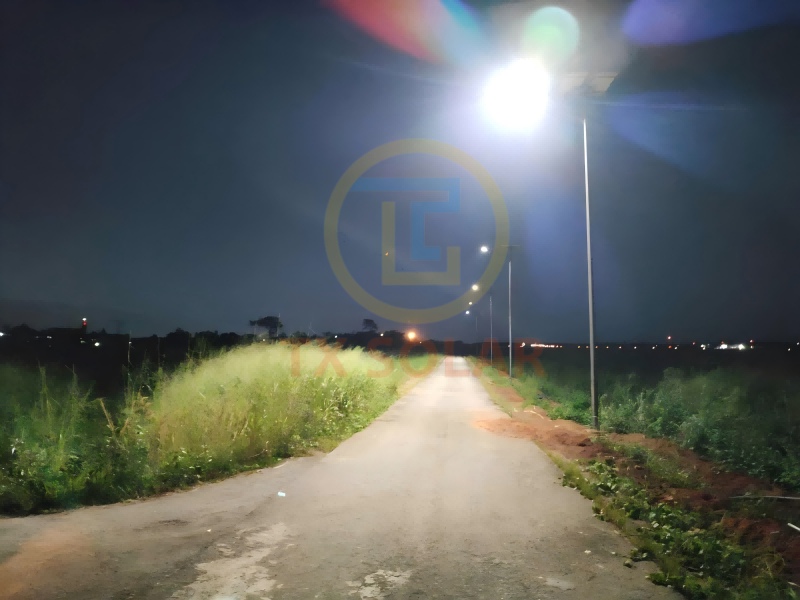
The installation height of solar powered street lights can affect the lighting area, and both the installation height and the spacing between lamp poles should be comprehensively considered. When the lighting fixtures of solar street light projects are installed at a lower height, although the light intensity near the lamp poles may be higher, the coverage area is smaller. Increasing the installation height of solar powered street lights usually changes the lighting coverage and distribution on the road. However, simply increasing the height of the lighting fixtures is not necessarily better, as the illuminance reaching the road surface also changes. Therefore, the appropriate installation height depends on the following factors: road width; spacing between lamp poles; output power of the lighting fixtures; optical distribution; arrangement of lamp poles; and required lighting level.
Optical distribution may be more important than power. Two 60W solar powered street lights may not necessarily produce the same road lighting effect. Even if their total luminous flux is similar, different lenses and optical designs can result in vastly different luminous flux distributions. One luminaire may concentrate most of its luminous flux near the lamp post, while another may spread more light longitudinally along the road and laterally onto the lanes. For road engineering projects, an appropriate asymmetric high-lumen solar street light optical system helps guide effective light to the road surface and improve light overlap between adjacent luminaires. This means that when evaluating high-lumen solar street lights, project designers should consider not only: power → lumens → brightness, but also: lumens → light distribution → road coverage → uniformity.
The width of the road can also affect the results. A lighting layout that performs well on a 5-meter-wide road may behave quite differently on a 10-meter-wide road. As the width of the road increases, the luminaires need to distribute effective light more widely across the road surface. Therefore, designers must consider the relationship between road width, installation height, illumination range, light distribution, and lamp post spacing, rather than viewing each parameter in isolation.
Therefore, ideally, photometric calculations should be completed before the final determination of the installation layout and solar system configuration. For the high-lumen solar street light project purchaser, a simple shift in thinking can make a significant difference: instead of just asking “How bright is this solar street light?” ask “How evenly can it illuminate my road?” This question shifts the focus of the discussion from the specifications of a single product to the performance of the entire solar street light project.
Post time: Aug-19-2026


