
When it comes to buying garden post lights, a lot of people get confused about whether they should add light sensors and motion sensors. The thing is, these two features are better suited for different situations. If you just add them without thinking, it’s going to cost you more money, and if you pick the wrong setup, it’s going to be a hassle to use. So, to help you out, TIANXIANG, a garden post light company, is going to break down how to choose the right combination based on what you need, whether you’re an engineer or just a homeowner.
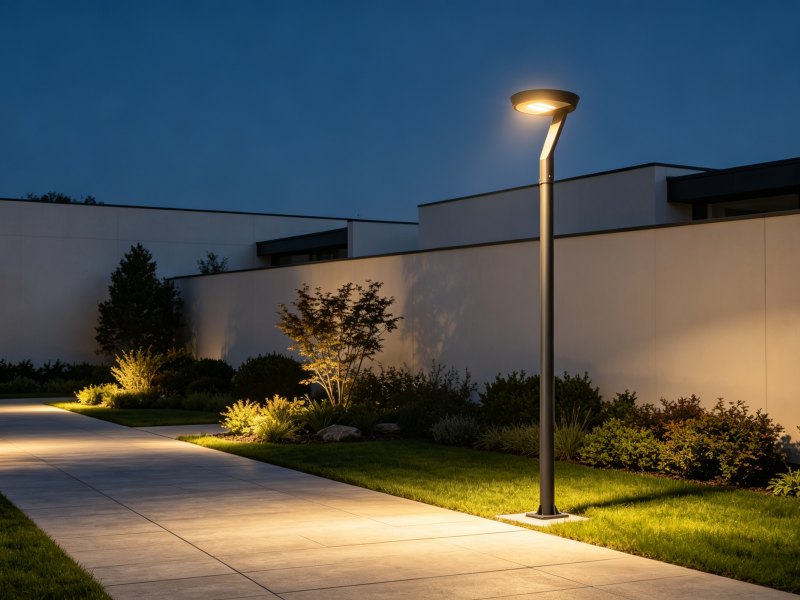
I. Light Sensor Function: Basic and practical, recommended for most scenarios.
Light sensor controllers rely on photosensitive elements to identify ambient brightness, automatically turning on at dusk and off at dawn, eliminating the need for manual switching.
When it comes to places that need lights on all the time, like walkways in neighborhoods, parks, and main roads in industrial areas, using light sensors can be a good way to save money. They get rid of the need for someone to turn the lights on and off, and they work automatically. But, when they’re just working on their own, the LED garden lamps stay on all night, which uses more energy. A common solution is to use sensors, which makes sure the modern LED garden lights are on steadily at night. The downside is that these modern LED garden lights can’t tell if someone is actually there or not, so they keep shining even when nobody’s around. This can be a problem because it wastes energy when no one needs the light. It would be better if the lights could somehow know when people are present and only turn on then. That way, we could save even more energy and make the whole system more efficient. Maybe someday we’ll have modern LED garden lights that can figure out when someone’s there and adjust themselves automatically. Until then, using solar garden lights with light sensors is still a pretty good option for keeping areas lit up at night without breaking the bank.
II. Human Body Sensing Function: Energy-Saving Preferred, Suitable for Low-Frequency Traffic Areas
Our bodies can be detected by sensors, mainly using radar or infrared. These sensors are often used in lighting systems. When someone is walking nearby, the garden post lights turn on at full strength. But when nobody is around, the lights dim down or switch off to save energy. This way, the garden post lights only shine brightly when needed, which is a pretty clever idea. It’s like having a smart lighting system that knows when to turn up or down the lights, making it more efficient and convenient.
These garden post lights are perfect for areas like villa courtyards, walking paths, and smaller parks. They can really help cut down on energy use, make solar light batteries last longer, and save on electricity bills. But, there are some downsides to sensor lights. For example, they stay bright in areas where people are always walking around, which isn’t ideal. And in the winter, when people are all bundled up and moving slower, some of these sensors don’t work as well. That’s why they’re not the best choice for busy main roads that need lights to be on all the time.
III. Two Functional Combination Schemes, How to Choose for Different Scenarios
1. Private Villa Courtyards:
Prioritize the combination of light sensing and human body sensing. After dark, the lights enter standby mode at low brightness, automatically turning on when someone passes by, balancing ambiance and energy saving.
2. Municipal Parks and Main Roads in Residential Communities:
Only light sensing is required. Continuous basic lighting throughout the night is needed to ensure pedestrian safety; the sensor function is not very practical and adds unnecessary costs.
3. Landscaped green belts and secluded paths in parks:
A combination of light sensors and motion sensors is recommended, balancing security and energy efficiency.
4. High-powered mains-powered landscape garden lights:
For high continuous lighting needs, it is recommended to install only light sensors, without motion sensors.
When buying sensors, keep in mind that more features mean higher costs, not just when you buy them, but also when you need to maintain them. These sensor parts are like any other electronic components, and they can stop working more easily than regular light fixtures, especially when they’re outside in hot and humid weather for a long time. So, if you don’t have a lot of money for your project and you just need basic lighting, a simple light sensor might be enough. But, if you want to save energy and don’t have a lot of people coming and going, adding a motion sensor can be a good idea. The best thing to do is choose what you need, and don’t pay for extra features you won’t use.
About TIANXIANG
TIANXIANG is a great place to find all sorts of modern LED garden lights. They make sure their light poles can withstand the outdoors by using a special double protection process – first, they hot-dip galvanize them, and then they add an extra layer of electrostatic powder coating. This way, the poles won’t rust easily. You can also get light sensors and motion sensors if you want. And the best part? You can customize the size and look of the lights to fit your villa, park, or residential area. If you’re looking to wholesale LED garden lamps, they’re happy to work with you!
Post time: Jul-28-2026


