
A successful outdoor lighting project involves much more than placing several lamps around a garden. The position, mounting height, beam distribution, color temperature, and control method of each fixture can influence safety, visual comfort, energy consumption, and the overall appearance of the landscape.
LED garden lighting offers designers and property owners considerable flexibility. It can illuminate pedestrian routes, define activity areas, emphasize landscape features, and make outdoor spaces more welcoming after dark. However, these results depend on careful planning.
In this guide, LED garden light manufacturer TIANXIANG explains how to develop an effective lighting plan for residential, commercial, and public outdoor spaces.
1. Identify the Purpose of Each Lighting Area
Before selecting fixtures, divide the site into functional zones. Different areas usually require different lighting effects.
Typical outdoor zones include:
Pedestrian paths and garden walkways
Building entrances and gates
Patios and outdoor seating areas
Driveways and parking entrances
Lawns and planted areas
Water features and sculptures
Steps, ramps, and changes in ground level
Boundary areas requiring additional visibility
A pathway needs consistent illumination that helps people recognize the walking surface. An outdoor seating area requires softer, more comfortable light. An entrance should be clearly visible, while decorative plants may only need subtle accent lighting.
Defining the purpose of each area prevents overlighting and makes it easier to select an appropriate landscape garden light for every location.
2. Study the Site Before Designing the Layout
A site assessment helps identify both lighting opportunities and installation restrictions.
Designers should examine the dimensions of the area, existing vegetation, building positions, pedestrian movement, electrical access, and possible mounting locations. Trees and shrubs may block light, while highly reflective walls or paving materials can increase perceived brightness.
The landscape may also change over time. A newly planted tree could eventually obstruct a fixture or create unexpected shadows. Allowing for future plant growth can reduce the need to reposition lights later.
It is also important to observe the site after sunset. Some areas that appear safe during the day may become difficult to navigate at night. A nighttime inspection can reveal dark corners, uneven steps, confusing intersections, and locations where glare may affect residents or drivers.
3. Create a Lighting Hierarchy
Uniform brightness across the entire garden often produces a flat and unnatural result. A better approach is to establish a hierarchy of light.
The most important areas, such as entrances, intersections, and steps, can receive slightly higher illumination. Secondary paths may use moderate light levels, while decorative zones can remain softer.
This variation helps guide people naturally through the space. It also creates visual depth and prevents unnecessary energy consumption.
The objective is not to make every part of the garden equally bright. Instead, the lighting should reveal important features while preserving appropriate contrast and a comfortable nighttime atmosphere.
4. Select the Right Light Distribution
Two landscape garden lights with the same wattage can produce very different results because of their optical systems. The beam angle and light distribution determine where the light reaches and how evenly it covers the ground.
A wide distribution can be useful for open lawns, plazas, and broad pedestrian areas. A narrower or more controlled beam may be better for paths, entrances, and landscape accents.
For pathway lighting, the beam should cover the walking surface without sending excessive light toward windows or neighboring properties. Asymmetrical optics can direct more light toward the required area while reducing wasted illumination behind the fixture.
Optical selection should therefore be based on the shape of the target area rather than wattage alone.
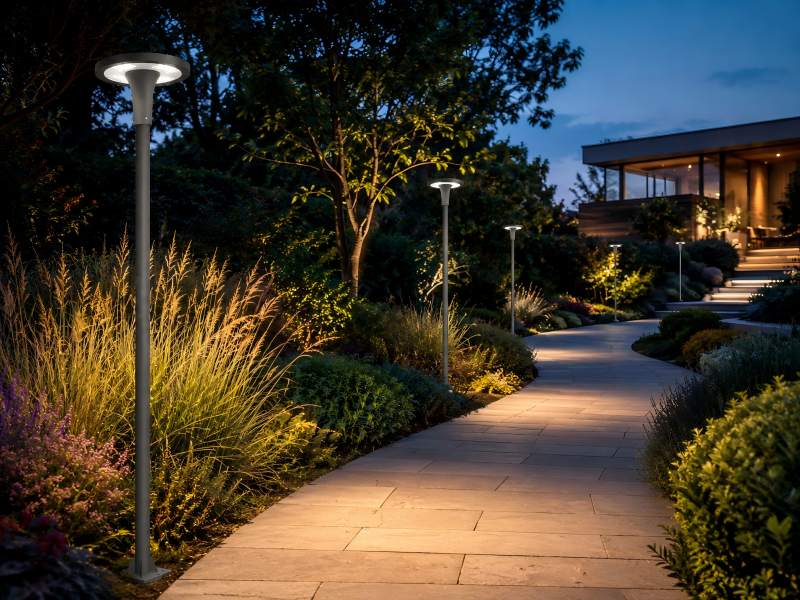
5. Determine Suitable Mounting Height and Spacing
Mounting height affects coverage, brightness, glare, and the visual scale of the installation.
Low-mounted fixtures can create an intimate atmosphere and clearly define narrow paths. Taller landscape garden lights provide broader coverage and may reduce the total number of fixtures required. However, excessively tall poles can appear out of proportion in small courtyards.
Fixture spacing must also be considered. Placing lights too far apart can create alternating bright and dark sections. Installing them too close together increases cost and may make the environment uncomfortably bright.
The ideal spacing depends on:
Mounting height
Fixture output
Beam distribution
Required illumination
Width of the pathway or activity area
Surrounding reflective surfaces
For commercial or municipal projects, photometric simulation is recommended before finalizing the layout. It allows the designer to evaluate illumination levels and uniformity before installation begins.
6. Choose an Appropriate Color Temperature
Color temperature strongly influences the atmosphere of an outdoor space.
Warm white light, typically around 2700K to 3000K, creates a relaxed and welcoming appearance. It is commonly used in private gardens, hotel courtyards, residential communities, and leisure areas.
Neutral white light, around 3500K to 4000K, offers clearer visibility and a more contemporary appearance. It can be suitable for public paths, commercial landscapes, entrances, and mixed-use outdoor areas.
Higher color temperatures may appear brighter, but they can also make a garden feel harsh if they are not used carefully. The surrounding architecture, paving colors, vegetation, and intended atmosphere should all influence the final decision.
Using a consistent color temperature across related areas helps create a coordinated visual effect.
7. Control Glare and Light Spill
Outdoor lighting should improve visibility without causing visual discomfort.
Glare often occurs when the LED source is directly visible from common viewing positions. Poor fixture placement may also direct unwanted light into nearby buildings, roads, or neighboring properties.
Glare can be reduced by:
Selecting fixtures with well-designed optical lenses
Using suitable mounting heights
Directing the light toward the intended surface
Avoiding excessive power
Maintaining appropriate spacing
Using shields or cut-off structures where necessary
Good glare control is especially important near seating areas, residential windows, vehicle routes, and building entrances.
The goal is to illuminate the environment—not the eyes of the people using it.
8. Consider Outdoor Durability
Landscape garden lights operate in changing weather conditions, so durability must be considered during product selection.
The fixture housing should provide suitable resistance to rain, dust, humidity, ultraviolet exposure, and temperature changes. In public areas, adequate impact resistance can help protect the fixture against accidental damage or vandalism.
Coastal locations require additional attention because salt spray can accelerate corrosion. A durable surface treatment, corrosion-resistant fasteners, and appropriate housing materials can improve reliability in these environments.
Buyers should evaluate the complete fixture, including the housing, sealing structure, optical components, driver, mounting connection, and surface finish. A high-quality LED chip alone cannot guarantee long-term outdoor performance.
9. Add Suitable Lighting Controls
Lighting controls can reduce unnecessary operating hours and adapt the installation to different usage patterns.
Common control options include:
Photocells for automatic dusk-to-dawn operation
Timers for scheduled switching
Motion sensors for low-traffic areas
Dimming programs for late-night operation
Centralized or smart control systems for larger projects
For example, a public garden may operate at full output during busy evening hours and switch to a lower output later at night. Motion detection can temporarily increase brightness when pedestrians enter a specific area.
The control strategy should match the actual activities of the site rather than applying the same schedule to every fixture.
10. Balance Function and Landscape Design
An LED garden light is part of the daytime landscape as well as the nighttime lighting system. Its shape, color, size, and pole design should coordinate with the surrounding architecture.
Modern buildings may suit clean, minimalist fixtures, while traditional gardens may require more decorative forms. The fixture should be visible enough to contribute to the landscape but not so dominant that it distracts from plants, paths, or architectural features.
Consistency is also important. Using too many unrelated fixture styles in one project can make the outdoor environment appear disorganized.
A well-planned system combines visual continuity with different optical performances for different functional areas.
Common LED Garden Lighting Planning Mistakes
Several mistakes can reduce the effectiveness of an outdoor lighting project:
Selecting fixtures only according to wattage
Installing all lights at equal spacing without considering site conditions
Using overly bright fixtures in small areas
Ignoring glare from normal viewing positions
Choosing a color temperature that conflicts with the landscape
Allowing trees or structures to block the light
Using one beam distribution for every application
Neglecting future vegetation growth
Failing to include maintenance access in the layout<>
Correcting these issues after installation can increase project costs. Detailed planning and photometric evaluation help reduce avoidable adjustments.
<sptyle=”font-size: medium;”>Conclusion
Effective LED garden lighting combines safety, comfort, energy efficiency, and landscape aesthetics. The best results come from understanding how people use the site and selecting appropriate fixtures, optics, mounting heights, color temperatures, and control methods for each area.
Rather than focusing on brightness alone, designers should consider the complete nighttime environment. Controlled illumination, balanced contrast, and coordinated fixture design can transform a garden into a safe and attractive space after sunset.
TIANXIANG is an experienced outdoor lighting manufacturer offering landscape garden lights for residential communities, parks, pathways, commercial landscapes, and public projects. If you are planning an LED garden lighting project, contact us to discuss fixture selection, technical requirements, and customized lighting solutions.
Post time: Aug-13-2026


