
For street lighting projects, welding quality directly affects the strength and long-term stability of the street lighting pole. Longitudinal seams, base flanges, reinforcement ribs, lamp arms, brackets, and access-door frames all rely on welded connections. If weak or incomplete welds are not identified before delivery, they may later lead to cracking, deformation, coating damage, installation problems, or reduced structural reliability under wind loading.
For this reason, street light pole welding quality should be checked before shipment instead of being judged only by the finished appearance. A practical inspection should combine drawing review, visual examination, dimensional checks, quality records, and non-destructive testing when required by the project.
1. Confirm the Drawing and Welding Requirements
Before inspecting the pole itself, check the approved drawing, material specification, weld locations, and project acceptance requirements. The inspector should know which joints require continuous welding, where reinforcement is installed, and whether a specific welding standard or test method is required.
This is important because a smooth-looking weld is not automatically a qualified weld. Different parts of a street light pole carry different loads, so the acceptance criteria should follow the drawing and project specification rather than appearance alone.
2. Inspect the Longitudinal Seam
Steel street light poles are commonly formed from bent steel plate, creating a longitudinal seam along the shaft. This seam should be checked along its full length.
The weld should be continuous and reasonably uniform. Watch for visible cracks, open sections, deep undercut, excessive overlap, large pores, burn-through, or areas that appear incompletely welded. Sudden changes in weld width or irregular repair marks also deserve attention.
At the same time, inspect the pole profile beside the seam. Excessive heat input or poor welding control can cause local distortion. The shaft should remain straight and consistent in shape, especially on tapered or polygonal poles.
3. Pay Special Attention to the Base Flange
The connection between the pole shaft and the base flange is one of the most important welded areas because it transfers structural loads into the foundation.
Inspect the full flange connection for cracks, gaps, incomplete sections, excessive undercut, and irregular starts or stops. If reinforcement ribs are used, check that they are securely attached to both the shaft and flange.
Welding can also distort the flange. Before shipment, confirm that the flange remains flat, the bolt-hole pattern is correct, and the pole shaft is properly aligned with the base. Poor alignment may cause serious installation difficulties even when the weld itself appears strong.
4. Check Door Openings, Arms, and Small Brackets
Smaller welded parts should not be ignored. The hand-hole or access-door area, electrical brackets, lamp-arm connectors, mounting plates, and decorative accessories can all affect installation and serviceability.
Around the door opening, check that reinforcement parts are firmly welded and that the opening has not been distorted. The door should still fit correctly after fabrication and surface treatment.
For lamp arms and mounting brackets, inspect both weld quality and position. Confirm the required arm angle, mounting direction, and dimensions so the luminaire can be installed without field modification.
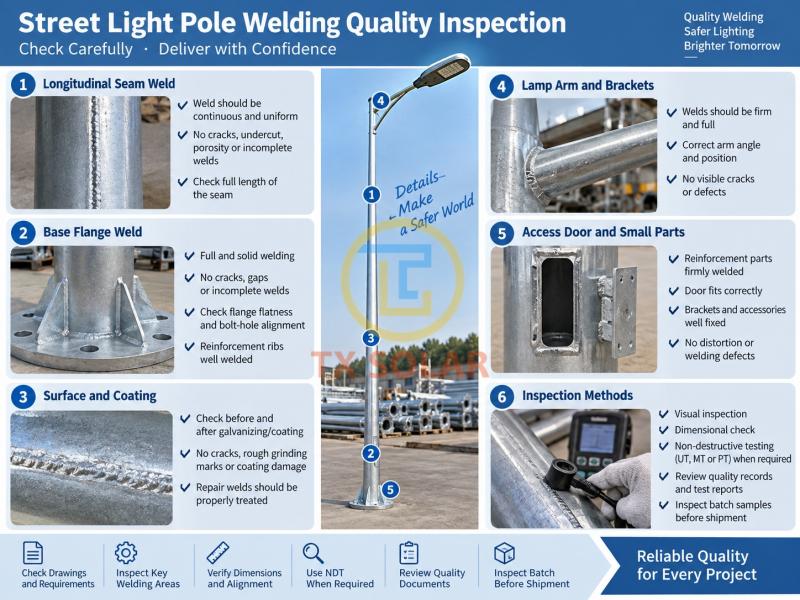
5. Review Welds Before and After Surface Treatment
Many welding defects are easier to identify before hot-dip galvanizing or powder coating. Zinc buildup and coating layers can make small surface defects more difficult to judge later. Therefore, a reliable quality-control process should include inspection during fabrication, not only after finishing.
Before shipment, conduct another check on the completed pole. Look for unusual coating buildup around welds, exposed steel, cracks, rough grinding marks, or repaired areas that appear inconsistent with the surrounding surface.
Repair welding is not necessarily a problem, but the defect should be fully removed, correctly rewelded, and inspected again before the pole is accepted.
6. Check Dimensions and Welding Distortion
Welding quality is closely related to dimensional accuracy. Excessive heat or an unsuitable welding sequence may bend the pole, twist the shaft, or distort the flange.
Measure key dimensions such as pole length, flange position, bolt-hole spacing, arm orientation, and important diameters or across-flat dimensions. Check shaft straightness from more than one direction.
For poles supplied in multiple sections, confirm that the connection or slip-joint area fits correctly. A repeated dimensional error across a large batch can create major delays during installation.
7. Use Non-Destructive Testing When Required
Visual inspection is the first step, but it cannot detect every internal discontinuity. For critical projects, high wind-load designs, high-mast structures, or contracts with special inspection requirements, non-destructive testing may be required.
Depending on the joint and specification, methods can include ultrasonic testing, magnetic particle testing, or liquid penetrant testing. The test method, inspection percentage, and acceptance level should follow the project specification or applicable welding standard.
If NDT is included in the order, buyers should request the actual inspection report instead of accepting only a general statement that the welds were tested.
8. Review Quality-Control Documents
Pre-shipment inspection should cover documents as well as finished poles. Relevant records may include approved drawings, material certificates, welding procedure documents, welder qualification records where required, repair records, dimensional inspection sheets, NDT reports, and final inspection records.
For larger orders, batch traceability is also important. The documents should be linked to the actual poles being shipped through batch numbers, tags, order references, or another identification method.
Good documentation makes it easier to confirm that inspection was carried out during production rather than only after the finished poles were prepared for delivery.
9. Inspect the Batch Before Packing
For mass production, inspecting only one pole is not enough. Select samples from different parts of the production batch and check the main weld areas, dimensions, and finished appearance.
If the same defect appears repeatedly, the inspection scope should be expanded. Repeated problems may indicate a process issue rather than an isolated defect.
A clear release standard should be used before packing. Poles with cracks, missing weld sections, serious undercut, unacceptable distortion, incorrect flange alignment, or unresolved inspection findings should be repaired and reinspected before shipment.
Random inspection also helps buyers determine whether manufacturing quality remains consistent throughout the entire order rather than only on the first approved sample.
Why Pre-Shipment Welding Inspection Matters
Discovering a welding problem after the poles arrive at the project site can be expensive. Returning large steel poles is difficult, while on-site repair may require qualified welders, lifting equipment, surface-treatment repair, and additional inspection.
Installation schedules can also be affected if flange dimensions, pole straightness, or arm positions are incorrect.
A structured factory inspection therefore helps identify problems while corrective work can still be completed under controlled manufacturing conditions. It also gives buyers clearer evidence that the supplied poles correspond to the approved project requirements.
For manufacturers, consistent welding inspection is equally valuable. Inspection records can reveal recurring production issues and help improve welding parameters, fixture design, operator control, and fabrication consistency in future batches.
Conclusion
Inspecting street light pole welding quality before shipment involves much more than checking whether the weld bead looks smooth. A complete evaluation should cover the longitudinal seam, flange connection, reinforcement ribs, access-door area, lamp-arm brackets, dimensions, repair history, test reports, and batch consistency.
For project buyers, the best approach is to define welding and inspection requirements before production and verify them again before delivery. This reduces the risk of structural defects, installation delays, and disputes after the poles reach the project site.
By combining physical inspection with documented quality-control records, buyers can make a more reliable shipment decision and ensure that street light poles meet the intended structural and installation requirements.
Post time: Sep-15-2026


