
Approving an LED street light sample should mean more than checking whether it switches on. Before committing to a bulk order, buyers need a clear record of what they are approving: the product configuration, measured performance, installation details, and requirements that production units must follow.
A useful approach is to treat the sample as the starting point for an acceptance standard rather than a simple product demonstration. The following evaluation process helps purchasing teams turn a physical sample into a documented basis for supplier selection and bulk-order inspection
Establish Exactly What the Sample Represents
Before testing begins, assign the sample an identification number and connect it to a specific quotation and technical specification.
Record the luminaire model, rated input power, supply voltage, LED configuration, driver model, optical lens, color temperature, mounting dimensions, and control options. Ask the supplier to identify any differences between the submitted sample and the proposed production version.
For example, a sample supplied with a premium driver should not be approved for an order quoted with a different driver unless that change has been reviewed. Similarly, approval of one lens configuration should not automatically extend to every optical option in the same housing.
Agree on acceptance criteria before collecting results. This gives both parties a common reference when deciding whether a measurement is acceptable or requires further investigation.
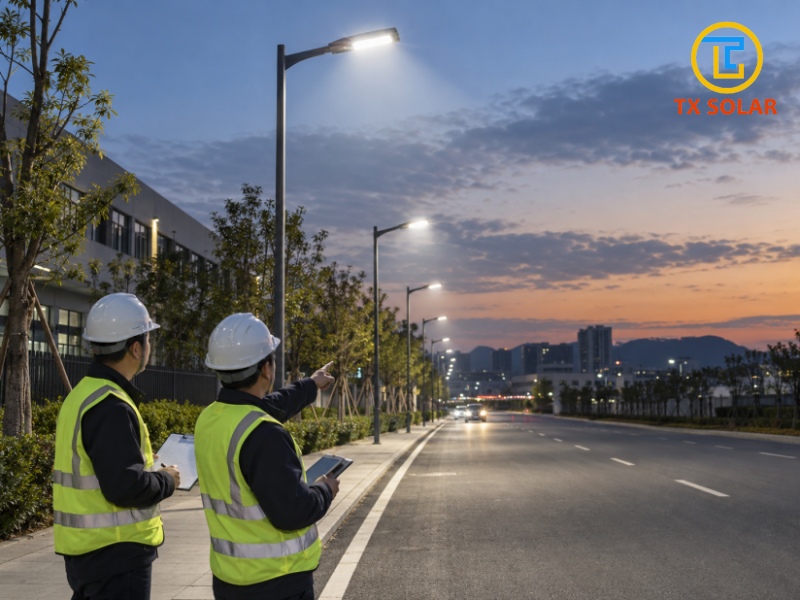
Inspect Installation Fit and Maintenance Access
Start with an unpowered visual and mechanical inspection. Photograph the housing, optical cover, mounting bracket, cable entry, product label, and packaging before making adjustments.
Check for cracks, damaged threads, loose hardware, uneven closure, and visible defects around sealing surfaces. Have a qualified installer trial-fit the sample to a representative mounting arm using the manufacturer’s instructions. Confirm the insertion depth, adjustment range, cable-routing space, and access to fastening points.
Also ask the installer to assess maintenance access. Can the driver compartment be opened safely after electrical isolation? Are component labels readable? Can a replaceable driver be removed without disturbing the optical assembly? Does the enclosure close properly afterward?
Record these observations alongside electrical results. A sample approval form should capture installation and servicing requirements, not just appearance.
Measure Actual Input Power Under Controlled Conditions
Have qualified personnel use a calibrated power analyzer to measure the complete luminaire at the agreed supply voltage and operating setting. Allow the product to stabilize before recording the acceptance measurement, and document the test conditions so the result can be reproduced. Standardized LED measurement methods address electrical conditions, operating orientation, and stabilization because these affect meaningful comparison.
Record real input power in watts, along with input voltage and any power-factor or harmonic-distortion values required by the project specification. Investigate differences from the quotation rather than immediately assuming that higher or lower power is better.
The relevant purchasing figure is the consumption of the assembled product. LED component specifications alone do not account for the complete fixture and power-supply performance
Verify Light Output and Road Coverage Separately
Request a photometric report that identifies the tested product and its configuration. Where specified, an ANSI/IES LM-79 report provides standardized measurements covering electrical power, luminous flux, system efficacy, light distribution, and color quantities. Match the report to the sample rather than accepting results for an unrelated model.
Compare measured luminaire efficacy using:
Luminaire efficacy = total luminaire light output ÷ complete luminaire input power
For illustration, a luminaire producing 15,000 lumens while consuming 100 watts has an efficacy of 150 lumens per watt. This is a calculation example, not a universal acceptance threshold.
Next, evaluate where the light goes. Use the matching photometric file in a lighting calculation with the project’s road width, mounting height, pole spacing, setback, and luminaire angle. Total lumen output alone cannot establish whether adjacent luminaires will provide suitable road coverage and uniformity.
For a field trial, agree on measurement positions in advance. Do not approve the sample from a single bright spot directly beneath the lamp; compare the relevant measurement grid with the project’s lighting criteria.
Review Temperature and Operating Behavior
Ask for temperature measurements taken with the luminaire operating in its intended orientation and under documented environmental conditions. Measurements should use appropriate component test points, including the driver case measurement point where applicable, rather than relying on whether the outer housing feels hot. Recognized in-situ measurement methods address component temperatures, mounting conditions, thermal stability, and reporting.
Compare the results with the relevant component limits and the luminaire’s declared operating conditions. Thermal management matters because elevated LED operating temperatures can accelerate light-output degradation.
During the agreed operating trial, record any unexpected shutdown, flickering, restart, or change in output. For samples with dimming or photocell control, test the supplied accessories and programmed settings, including behavior after power is restored.
Keep the conclusion proportionate to the test. An overnight trial documents short-term operation; it does not establish years of reliability. LED product reliability also involves electronics and color stability, not only whether the LEDs continue emitting light.
Check Evidence Behind Protection Claims
Treat an advertised protection rating as a claim that needs supporting documentation. IEC 60529 defines the classification of protection provided by electrical enclosures through the IP Code. Request evidence supporting the rating specified for the order and check that it applies to the submitted luminaire configuration.
Review the report’s product identification, photographs, enclosure arrangement, cable entries, and relevant test conditions. Ask for clarification when the sample differs from the tested construction.
Do not use an informal water-spray demonstration as the sole basis for accepting an IP claim. Have any verification testing performed by a suitably equipped laboratory under the applicable procedure.
Apply the same document-matching discipline to electrical safety, surge protection, and other requirements in the project specification. Missing evidence should remain an open approval item rather than being overlooked because the sample appears well finished.
Turn Sample Approval Into a Production Reference
The final step is to define how the approved sample will control the bulk order.
Retain an identified reference sample and a signed approval record containing photographs, configuration details, test results, and agreed tolerances. Request written approval before changes to the driver, LED module, optics, sealing components, wiring, or control settings are introduced.
Use a clear decision status: approved, revise and resubmit, or rejected. For conditional approval, list every unresolved item and the evidence required to close it. Avoid a vague “sample confirmed” message that leaves technical exceptions undocumented.
Before shipment, arrange inspection of randomly selected production units against the approved specification and reference sample. Include configuration checks as well as the agreed performance tests. Sample approval should support production inspection, not replace it.
Also clarify the warranty procedure, replacement-component arrangements, and records needed for a claim before releasing the bulk order.
Conclusion
An effective LED street light sample evaluation produces more than a favorable first impression. It creates a traceable connection between the quotation, the tested product, and the units that will ultimately be delivered.
The purchasing decision should therefore consider installation fit, verified electrical and optical performance, operating behavior, supporting documentation, and production consistency together.
Planning a bulk LED street light order? Share your road layout, electrical requirements, mounting details, and acceptance criteria with TIANXIANG to discuss the appropriate sample configuration before production.
Post time: Sep-22-2026


