
Brighter is not always better when it comes to solar road lighting. Excessive brightness or improper light distribution can cause visual discomfort for drivers and pedestrians, and may even make it more difficult to see roads, people, and obstacles clearly. Therefore, glare control should be considered from the fixture selection, optical design, and installation layout stages rather than addressed after installation.
Main Causes of Solar Street Light Glare
Solar street light glare can occur when a high-brightness light source enters the field of view directly or when there is a significant brightness difference between the road and its surroundings. Common causes include:
Excessive luminaire output;
Improper LED light distribution;
Excessive upward fixture tilt;
Inappropriate pole spacing or installation position;
High-brightness light sources directly exposed to drivers’ line of sight;
Excessive contrast between bright and dark areas on the road.
These factors often interact with each other, so simply reducing the lamp power may not completely solve the problem.
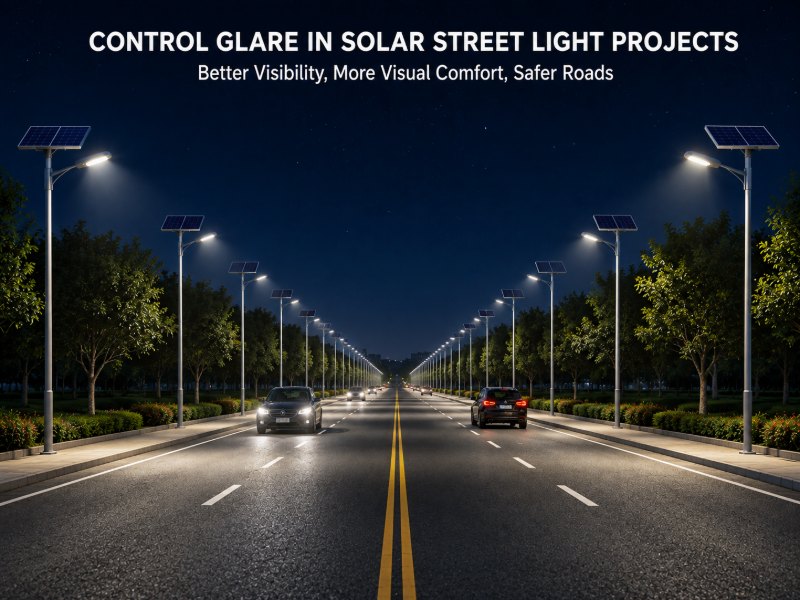
1. Choose the Right Optical Distribution
The key to controlling glare of solar street light projects is directing light precisely to the areas of the road that require illumination. A well-designed lens and optical system can reduce unnecessary high-angle light, prevent excessive light from entering the eyes of pedestrians and drivers, and improve lighting uniformity on the road.
When selecting solar street light projects, wattage and lumen output should not be the only considerations. Photometric distribution, light distribution curves, and actual road coverage should also be evaluated. Proper optical distribution can provide better illumination coverage, reduce wasted light, and create a more comfortable visual environment.
2. Avoid Excessive Upward Fixture Tilt
Properly adjusting the solar street light glare angle can improve lighting coverage. However, if the fixture is tilted too far upward, the LED emitting surface may become directly visible to road users, increasing the risk of direct glare.
The installation angle should be determined based on pole height, road width, arm length, the distance between the pole and the road, and the fixture’s optical distribution. The goal is not to make the light reach as far as possible, but to direct it accurately toward the target area.
3. Do Not Use Excessive Brightness to Compensate for Layout Problems
If road illumination is insufficient, simply increasing fixture power may only create brighter local areas without improving illumination farther away. Excessive pole spacing or unsuitable light distribution is often the underlying cause of poor lighting uniformity.
Therefore, luminaire output, optical distribution, pole position, and spacing should be evaluated together. Optimizing the overall layout should take priority over simply increasing brightness.
4. Evaluate Glare from the User’s Perspective
For motor vehicle roads, special attention should be paid to whether drivers approaching the luminaire have a direct view of the high-brightness light source. For sidewalks, parks, and residential roads, pedestrian viewing height and direction of travel should also be considered.
Simulating actual viewing positions during the design stage can help identify potential glare risks in advance and allow designers to adjust fixture angles, mounting heights, or optical configurations accordingly.
5. Reduce Bright-Dark Contrast and Use Appropriate Dimming
Solar road lighting should not only meet illuminance requirements but also avoid creating obvious isolated bright and dark areas. Excessive brightness variation can increase visual strain for drivers and pedestrians at night.
Solar street light projects can also use different dimming strategies depending on the time of night. Higher output can be maintained during peak traffic periods, while brightness can be reduced appropriately late at night when traffic volume is lower. This can reduce unnecessary glare, lower energy consumption, and extend battery operating time. However, dimming should never reduce lighting below the minimum requirements specified for the project.
6. Conduct Lighting Simulation Before Installation
For medium and large-scale projects, professional lighting software such as DIALux is recommended for simulation before installation. In addition to average illuminance, designers should evaluate lighting uniformity, pole layout, light distribution, high-brightness areas, and relevant glare indicators.
TIANXIANG can provide solar street light configurations and DIALux design support based on road width, pole height, installation spacing, and required lighting duration, helping customers optimize their lighting solutions before construction.
Conclusion
A well-designed solar road lighting project should not simply aim to “look bright.” Road visibility, lighting uniformity, and visual comfort are equally important. Through proper optical distribution, correct installation, scientific layout planning, appropriate dimming, and professional lighting simulation, glare can be effectively reduced to create a safer, more comfortable, and energy-efficient nighttime lighting environment.
Post time: Aug-25-2026


