
Roadside trees can make streets cooler, greener, and more attractive. They also provide valuable shade for pedestrians and help improve the appearance of residential roads, parks, and public spaces.
However, when solar powered street lighting systems are installed along tree-lined roads, the relationship between vegetation and lighting equipment deserves careful consideration.
Unlike conventional grid-connected street lights, solar street light projects depend on sunlight to recharge their batteries. If trees repeatedly block sunlight from reaching the photovoltaic panel, the system may collect less energy during the day. Over time, this can affect nighttime lighting performance, especially during periods of cloudy weather or when energy consumption is relatively high.
Therefore, trees do not necessarily make solar powered street lighting systems unsuitable. The key is understanding when, where, and how much shading occurs.
The photovoltaic panel needs sufficient solar radiation to generate electricity. When branches or leaves block part of the panel, the amount of solar energy reaching the photovoltaic surface can decrease.
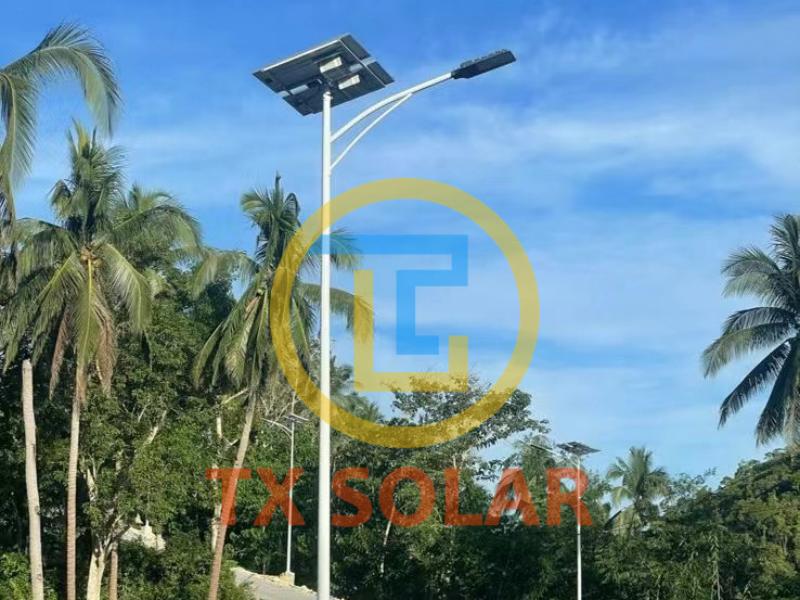
The effect of rural solar street lights depends on several conditions, including:
The height and density of the trees
The distance between trees and lamp poles
The position and orientation of the solar panel
The time of day when shading occurs
Seasonal changes in the sun’s position
The duration of the shade
The local solar radiation conditions
A tree that creates a short period of afternoon shade may have a very different impact from a large tree that blocks the panel for most of the day.
This means that simply saying “trees are bad for solar street lights” is not accurate. The actual issue is insufficient solar exposure.
Morning Shade and Afternoon Shade Are Not Always Equal
One important consideration is when the solar panel becomes shaded.
Solar radiation changes throughout the day. A tree may block the panel during the morning, around noon, or in the afternoon depending on its position relative to the lamp pole and the sun.
For example, a lamp installed on one side of a road may receive good sunlight during one part of the day but become shaded when the sun moves behind a row of trees.
The same tree can therefore have different effects at different times of the year.
This is particularly important for solar street light projects because installation decisions are often made based on the appearance of the site on a single day. A location that looks sunny during installation may experience considerably more shade later in the year.
Seasonal Tree Growth Can Change Solar Conditions
Trees are not static obstacles.
Branches grow, tree crowns become wider, and seasonal foliage can dramatically change the amount of sunlight reaching a solar panel.
A location with sufficient sunlight immediately after installation may gradually become more challenging as nearby vegetation develops.
Deciduous trees create another type of seasonal variation. During winter, their bare branches may allow more sunlight to reach the panel. During spring and summer, dense leaves can create substantially more shade.
Evergreen trees can provide a more consistent obstruction throughout the year.
For long-term solar street light projects, it is therefore useful to consider not only the current condition of the trees but also their expected growth.
Partial Shading Can Still Reduce Energy Generation
It is easy to assume that a solar panel will continue producing almost the same amount of electricity if only part of its surface is covered by leaves or branches.
In reality, the effect of partial shading depends on the panel’s electrical configuration, bypass protection, the location of the shaded area, and the intensity of the obstruction.
A small amount of shade may have a limited effect, while certain types of partial shading can cause a larger reduction in the usable output of a photovoltaic module.
For this reason, the objective should not simply be to find a location where the panel receives “some sunlight.”
The better goal is to provide reliable and useful solar exposure throughout the charging period.
A good solar powered street lighting system installation should therefore consider both energy collection and long-term maintenance.
How Far Should a Solar Panel Be From Trees?
There is no single universal distance that works for every solar street light project.
The required clearance depends on:
Tree height
Crown diameter
Solar panel dimensions
Pole height
Panel orientation
Road direction
Geographic latitude
Seasonal sun angles
Expected tree growth
A short tree located several meters away may create less shading than a much taller tree located farther from the rural solar street light pole.
For this reason, solar street light project engineers should evaluate the relationship between the tree canopy and the solar panel rather than using a fixed distance as the only design rule.
Post time: Sep-01-2026


