
Outdoor pathways connect entrances, gardens, residential buildings, parking areas, recreational facilities, and public spaces. Although these routes may appear simple to illuminate, an effective pathway lighting system requires more than installing bright lamps at regular intervals.
Pedestrians need to recognize changes in ground level, identify the direction of the route, notice nearby obstacles, and see other people without being disturbed by excessive glare. The optical design of an LED courtyard light directly affects all of these conditions.
A well-designed fixture distributes light precisely across the walking surface instead of allowing it to scatter into windows, vegetation, or the night sky. In this article, LED garden light manufacturer TIANXIANG explains how optics, positioning, uniformity, and glare control contribute to safer and more comfortable pathway lighting.
What Are LED Garden Lamp Optics?
LED courtyard light optics are the components that control the direction and distribution of light emitted by the LED source. Depending on the fixture design, the optical system may include lenses, reflectors, diffusers, covers, or a combination of these components.
Without suitable optical control, a large proportion of the light may reach areas where it is not needed. The fixture can appear bright when viewed from a distance while producing insufficient illumination on the ground.
An effective optical system directs the available light toward the intended area. This makes it possible to achieve better visibility without simply increasing power consumption.
The optical design influences:
Beam width
Lighting distance
Ground coverage
Illumination uniformity
Glare level
Light spill
Fixture spacing
Perceived brightness
For this reason, wattage alone cannot determine whether an LED garden lamp is suitable for a particular pathway.
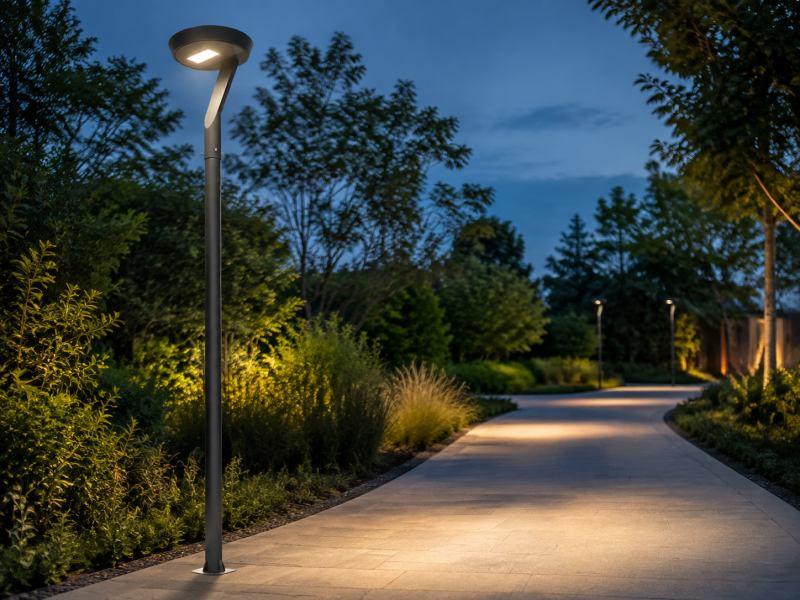
Why Is Uniformity Important on Garden Paths?
Uniformity describes how consistently light is distributed across an illuminated area. A pathway with poor uniformity contains very bright sections followed by dark sections.
When pedestrians move repeatedly between these areas, their eyes must continually adapt to different brightness levels. A deep shadow immediately after a bright pool of light can make a step, curb, branch, or uneven paving surface more difficult to notice.
Better uniformity does not mean that every point must have exactly the same brightness. Instead, the transition between brighter and darker areas should be gradual enough to support comfortable movement.
Uniform pathway lighting can help users:
Follow the direction of the route
Recognize the edges of the pavement
Identify surface changes
Notice obstacles earlier
See approaching pedestrians
Maintain visual comfort while walking
Uniformity is particularly important for routes used by children, elderly residents, hotel guests, and people unfamiliar with the site.
Symmetrical and Asymmetrical Light Distribution
Commercial LED garden lights can use different light distributions according to the shape and function of the target area.
Symmetrical distribution
A symmetrical optical system distributes light relatively evenly around the fixture. It can be suitable for open courtyards, small gathering areas, intersections, lawns, and locations where illumination is required in several directions.
However, when a symmetrical fixture is installed beside a narrow path, part of its output may fall behind the pole or into planted areas. This light may contribute little to pedestrian visibility.
Asymmetrical distribution
An asymmetrical optical system directs more light toward one side of the fixture. When installed beside a path, it can place a greater proportion of the light on the walking surface.
This distribution may provide:
Better coverage across the width of the path
Longer lighting distance between fixtures
Less wasted light behind the pole
Reduced light entering nearby buildings
More efficient use of the fixture output
The most appropriate option depends on the pathway width, pole position, mounting height, landscaping, and required visual effect.
Beam Angle and Pathway Width
Beam angle determines how widely the light spreads after leaving the fixture.
A narrow beam concentrates light within a smaller area and may create strong brightness directly below or in front of the lamp. A wide beam covers a larger area but may provide lower intensity at more distant points.
For a narrow garden path, an excessively wide beam can illuminate surrounding lawns and windows unnecessarily. On a broad pedestrian route, a beam that is too narrow may leave the edges dark.
The beam should cover the complete usable width of the pathway while maintaining a smooth connection with the light from adjacent fixtures.
When evaluating a fixture, project designers should consider the actual photometric distribution rather than relying only on descriptions such as “wide beam” or “high brightness.” Photometric data and lighting simulations provide a more reliable basis for comparison.
How Mounting Height Affects Light Distribution
Mounting height works together with the optical system.
When an LED courtyard light is mounted higher, its light can cover a larger area. However, the illumination reaching the ground may become less concentrated. Higher mounting can also make the fixture more visible from a distance, so glare control becomes increasingly important.
A lower mounting height creates a more intimate landscape scale and can provide strong illumination near the fixture. However, it may require shorter spacing to prevent dark gaps.
The mounting height should correspond with:
Pathway width
Required lighting distance
Fixture output
Optical distribution
Surrounding trees and buildings
Desired daytime appearance
Risk of accidental impact or vandalism
The correct height cannot be selected independently from the fixture’s photometric performance.
Preventing Glare from Commercial LED Garden Lights
Glare occurs when excessive brightness within the field of view makes seeing uncomfortable or more difficult. It is one of the most common problems in poorly designed outdoor lighting.
An LED garden lamp may illuminate the ground effectively but still cause discomfort if pedestrians can directly see an intense LED source. The problem can become more noticeable when the surrounding environment is otherwise dark.
Glare may be controlled through:
Recessed LED modules
Carefully designed lenses and reflectors
Shields or cut-off structures
Suitable fixture orientation
Appropriate mounting height
Lower output with improved distribution
Correct spacing between fixtures
More power does not necessarily provide better safety. If the additional output creates glare, pedestrians may have greater difficulty seeing the path beyond the bright fixture.
The goal is to make the walking surface visible while keeping the light source visually comfortable.
Illuminating Steps, Curves, and Intersections
Not every part of a pathway requires the same lighting treatment. Certain locations deserve additional attention because they involve changes in movement or surface level.
Steps and ramps
The top and bottom of a staircase should be clearly visible. Light should help distinguish the edge of each step without creating misleading shadows.
For ramps, illumination should reveal the direction and slope of the surface. Fixtures must be positioned so that handrails or nearby plants do not block the light.
Curved pathways
Lights placed along the inside or outside of a curve can visually indicate the direction of travel. The spacing may need to change where the curve becomes tighter.
Path intersections
Intersections should be easy to recognize from a distance. A slightly higher level of illumination or a carefully positioned fixture can help users identify route choices.
Entrances and gates
Transitions between a path and a building entrance often require additional vertical illumination. This helps users recognize doors, signs, locks, and people approaching from the opposite direction.
A successful lighting design responds to these individual conditions instead of applying identical spacing throughout the entire site.
Horizontal and Vertical Illumination
Pathway lighting is often evaluated according to the amount of light reaching the ground. This is known as horizontal illumination.
Horizontal illumination helps pedestrians identify paving, steps, water, fallen objects, and changes in ground level. However, it is only part of the visual environment.
Vertical illumination affects how well people can see faces, signs, gates, plants, and objects located above the walking surface. A system focused entirely on the ground may produce bright paving but leave the surrounding area visually unclear.
Commercial LED garden lights should provide an appropriate balance. Controlled vertical light can improve spatial awareness, while excessive upward or sideways output should be avoided.
Reducing Unwanted Light Spill
Light spill occurs when illumination extends beyond the intended area. On garden paths, unwanted light may enter residential windows, disturb neighboring properties, or reduce the nighttime character of the landscape.
It can also increase energy use without improving pathway visibility.
Light spill can be minimized by:
Choosing optics matched to the shape of the pathway.
Positioning fixtures carefully in relation to nearby buildings.
Using shields where additional control is required.
Avoiding unnecessarily high output.
Confirming fixture orientation during installation.
Dimming the system during periods of low pedestrian activity.
Proper optical control allows the lighting system to support safety while respecting the surrounding environment.
Why Fixture Spacing Should Not Be Based on Appearance Alone
Some projects arrange garden lights according to visual symmetry during the daytime. Although an orderly layout is desirable, equal spacing does not always produce an effective nighttime result.
Trees, walls, slopes, curves, and different paving materials can change how light reaches the ground. A rigid spacing pattern may place one fixture behind dense vegetation or leave an important intersection insufficiently illuminated.
Spacing should be determined by both landscape design and lighting performance.
Before installation, a project team should evaluate:
Illuminance between fixtures
Bright and dark transitions
Path edge visibility
Obstructions
Glare from common viewing directions
Lighting at entrances and intersections
Effects on nearby properties
For larger projects, professional lighting simulation can identify potential problems before foundations and cables are installed.
Selecting an LED Garden Lamp for Pathway Projects
When comparing fixtures, buyers and project contractors should request more than a wattage and product photograph.
Useful technical information includes:
Luminous flux
Light distribution curve
Beam type
Color temperature
Color rendering index
Ingress protection rating
Impact resistance rating
Driver and surge protection information
Recommended mounting height
Dimming compatibility
Fixture dimensions and mounting method
Buyers should also consider the housing material, surface treatment, sealing structure, thermal design, and accessibility of replaceable components.
A product that combines controlled optics with a durable outdoor structure can deliver more consistent performance throughout the service life of the project.
Can Smart Controls Improve Pathway Lighting?
Smart controls can adapt an LED garden lighting system to actual pedestrian activity.
For example, lights may operate at a reduced output late at night and increase to a higher level when motion is detected. This approach can reduce energy consumption while maintaining useful illumination when the pathway is occupied.
Possible control methods include:
Photocells
Time schedules
Motion sensors
Programmable dimming
Central management systems
Zone-based control
Changes in output should remain smooth and comfortable. Sudden brightness changes or lights switching off too quickly may confuse pedestrians.
Controls should support the optical design rather than compensate for poor fixture positioning or unsuitable light distribution.
Common Optical Design Mistakes
Several mistakes can reduce the safety and comfort of a pathway lighting system:
Selecting fixtures according to wattage alone
Using a narrow beam for a wide path
Directing excessive light toward nearby windows
Creating intense bright spots beneath each fixture
Leaving dark gaps between adjacent lights
Installing lamps where plants block the beam
Ignoring glare from pedestrian eye level
Using identical spacing around curves and intersections
Evaluating only ground brightness
Increasing power instead of improving optical control
Identifying these issues during the design stage can reduce installation changes and improve the final result.
Conclusion
Safe pathway lighting depends on where the light goes—not simply on how much light a fixture produces.
The optical system of an LED courtyard light determines ground coverage, uniformity, glare, light spill, and the visibility of surrounding objects. When suitable optics are combined with the correct mounting height, spacing, color temperature, and control strategy, a pathway becomes easier and more comfortable to use after dark.
TIANXIANG manufactures commercial LED garden lights for residential communities, parks, hotels, commercial landscapes, pedestrian routes, and public outdoor projects. We can provide product selection support and customized lighting solutions based on different mounting, environmental, and project requirements.
If you are preparing a LED garden lamp project, contact TIANXIANG for product specifications, quotations, and professional technical assistance.
Post time: Aug-13-2026


