
When selecting solar LED street lamps, wattage and lumen output are not the only factors that matter. Different road widths, lane configurations, pole positions, mounting heights, and spacing arrangements require different optical distributions. The main purpose of selecting the right optics of solar street lighting project is to direct as much useful light as possible onto the road while reducing wasted light.
Why Does Road Width Affect Optical Distribution?
The lens determines how light is distributed across and along the road. Narrow roads do not require an excessively wide lateral beam, as this may direct unnecessary light toward buildings, landscaping, or open areas. Wider roads, on the other hand, require greater lateral reach to ensure that lanes farther away from the pole receive sufficient illumination.
A practical lighting design process should follow this logic:
Road Width → Pole Position → Mounting Height → Optical Distribution → Pole Spacing → Lighting Simulation
Road width is an important factor, but it should never be used alone to determine the appropriate optics.
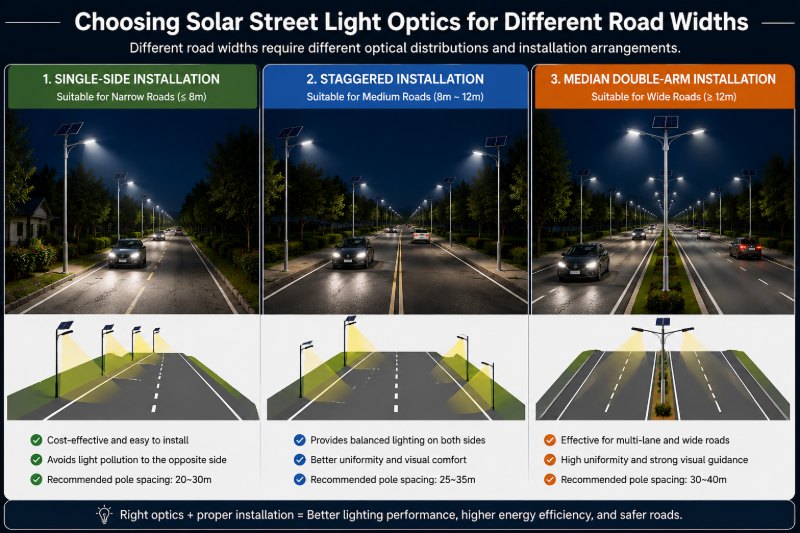
1. Narrow Roads: Reduce Wasted Light
Rural roads, residential streets, and internal roads are generally narrower. For these applications, the optical distribution should concentrate useful light on the road surface while maintaining continuous illumination between adjacent luminaires.
For a single-sided pole arrangement, it is important to confirm that the opposite side of the road receives sufficient light while avoiding excessive illumination behind the pole.
Key factors to consider include:
Effective road coverage
Illumination on both sides of the road
Pole spacing
Uniformity between adjacent luminaires
Spill light outside the roadway
The best option is not necessarily the widest beam distribution, but the one that best matches the actual road cross-section.
2. Medium-Width Roads: Balance Lateral and Longitudinal Coverage
As road width increases, the luminaire needs to illuminate lanes farther from the pole while also creating continuous lighting along the direction of travel.
If the light is excessively concentrated directly below the luminaire, darker areas may appear between poles. If the distribution is too wide, the light intensity reaching more distant areas may become insufficient.
Therefore, two dimensions need to be considered simultaneously:
Lateral coverage: The optics of solar street lighting project should provide sufficient illumination across the road width and required lanes.
Longitudinal coverage: The light pattern should provide appropriate overlap between adjacent luminaires.
This is why total lumen output alone cannot determine whether a solar LED street lamp is suitable for a particular road.
3. Wide Roads: Combine Optics with the Right Pole Arrangement
For wide roads or multi-lane roads, simply selecting a wider lens may not provide the best result. Attempting to illuminate the entire roadway from only one side can reduce light utilization efficiency and create uneven illumination.
Depending on the road structure, several pole arrangements may be considered:
Single-sided arrangement
Staggered arrangement
Opposite arrangement
Median-mounted arrangement
With poles installed on both sides of the road, luminaires can work together to cover the roadway. This means that each luminaire does not need to illuminate the entire road width independently, which can often provide better uniformity and more efficient use of available light.
4. Consider Mounting Height and Pole Position Together
Even when two roads have the same width, they may require completely different optical distributions if the mounting height, arm length, or fixture angle is different.
When selecting solar street light optics, the following parameters should therefore be evaluated together:
Road width
Luminaire mounting height
Pole setback from the road
Arm length
Fixture tilt angle
Pole arrangement
Together, these parameters determine the angle and distance at which light reaches the road surface.
5. Do Not Automatically Choose the Widest Beam
A wider beam does not necessarily mean better road coverage.
If the optical distribution is too wide, part of the available luminous flux may be directed outside the roadway. This reduces light utilization and may also create unnecessary spill light in residential areas, landscaping, or surrounding spaces.
For solar LED street lamps, inefficient distribution can also consume valuable battery energy without actually improving road illumination.
The more useful question is:
Which optical distribution directs the greatest amount of useful light onto the required road area?
The answer depends on the actual road geometry rather than simply choosing the widest available beam.
6. Verify the Design with Photometric Data and Simulation
Two luminaires with similar wattage and lumen output can produce very different lighting results because their optical distributions are different.
IES files, photometric distribution curves, and professional lighting software such as DIALux can be used to evaluate:
Maximum light intensity direction
Lateral and longitudinal coverage
Spill light outside the roadway
Overlap between adjacent luminaires
Average illuminance and lighting uniformity
The final solar street light optical selection should be verified according to road width, mounting height, pole spacing, and pole arrangement rather than being based only on experience or visual judgment.
Conclusion
Choosing the right solar street light optics is essentially a process of matching the luminaire’s light distribution to the actual road geometry.
Narrow roads generally require controlled distribution that minimizes wasted light. Medium-width roads require a balance between lateral coverage and longitudinal continuity. Wide and multi-lane roads require both suitable optics and an appropriate pole arrangement.
Instead of asking only how many watts or lumens a solar LED street lamp provides, project designers should consider where the light actually goes.
By combining road dimensions, mounting parameters, photometric data, and lighting simulation, a solar street lighting project can achieve better light utilization, more balanced road illumination, and more efficient use of solar energy.
Post time: Aug-25-2026


