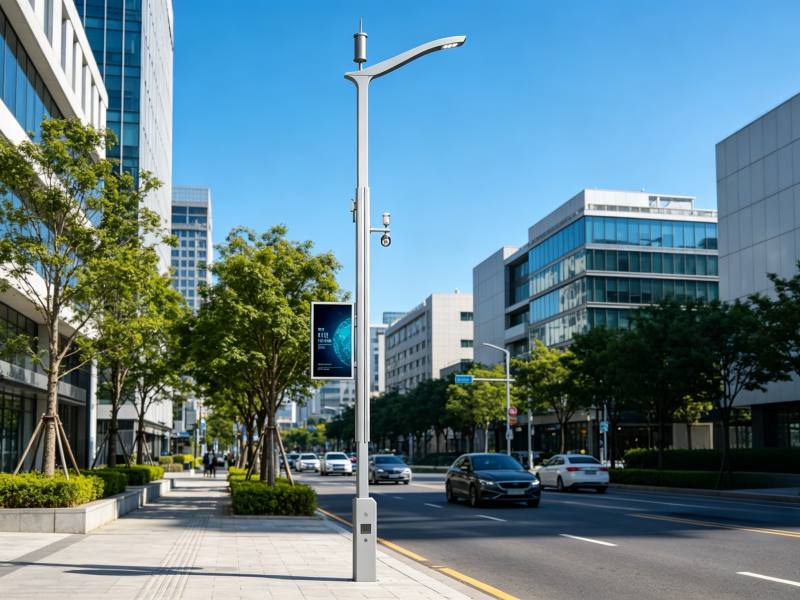
Smart city light poles are the core terminal devices of smart cities, and are different from traditional street lights with single lighting functions. They work smartly with the Internet of Things, sensor technology, and cloud platforms. It is based on three core links: information perception and collection, intelligent analysis and processing, and precise execution and feedback. These links work together to achieve autonomous control and efficient operation and maintenance of smart lighting.
1. Real-time Collection of City Data
Smart city light poles are based on terminal perception. It collects information on the environment and equipment status through various hardware devices, laying the groundwork for intelligent control and regulation.
First, a self-check of equipment status. Lamps and power supplies are constantly monitored for their operating status by the built-in current, voltage, and power sensors. They are able to accurately detect failures such as lamp damage, line failures, and power outages, and automatically record fault data and mark problem locations.
Secondly, dynamic environment acquisition. It is provided with illuminance, temperature, humidity, air quality, human body infrared, and other sensors, and collects data such as external light intensity, pedestrian and vehicle flow, and environmental quality in real-time to judge whether road lighting is required and whether there are abnormal conditions.
2. Intelligent Operation and Instruction Issuance
The cloud platform is the “brain” behind smart street lights. It is responsible for receiving terminal data, intelligent operation, and analysis, replacing manual management and decision-making.
First, summary and analysis of data. All data collected by terminals is uploaded to the cloud platform in real time through 5G and IoT modules. The system classifies, screens, and analyzes the huge data; gets rid of invalid data, and maintains effective monitoring information.
Second, automatic generation of instructions. The platform automatically generates regulation instructions based on preset programs and intelligent algorithms, depending on the changes in ambient light, time periods, and pedestrian flow. At the same time, it issues maintenance reminders and operation and maintenance work orders based on equipment fault data.
3. Accurate Implementation of Intelligent Regulation
The implementation of the functions of custom smart light poles is the key to the execution link. It receives cloud instructions and performs corresponding operations to form closed-loop feedback.
First, the regulation of smart lighting. It automatically turns on and off and dims steplessly as commanded. The lights are automatically dimmed in the late night when the traffic flow is low and turned off automatically in sufficient daylight, balancing the lighting demands with energy-saving effects.
Secondly, feedback and status update. At the end of the regulation operations, the equipment reports the latest operating status to the cloud and updates equipment accounts and monitoring data. It forms a complete closed loop of “collection-analysis-execution-feedback” which guarantees the long-term stable operation of equipment.
TIANXIANG custom smart light pole is equipped with sensors, dimming and IoT cloud control. Hot-dip galvanized poles are anti-corrosion and save more than 60% of energy. Custom multi-functions & remote one-click maintenance fit municipal & park projects.
Post time:
Jun-30-2026