
I. Industry Issues: Multiple Operating Entities, Lack of Coordination
Who will operate smart road lights? Different operators will have different focuses. For example, if a telecommunications operator or a city construction company operates them, they may overlook aspects less directly related to their role.
Who will coordinate smart road lights? Construction plans involve different fields such as telecommunications, meteorology, transportation, urban construction, and advertising management, falling under the jurisdiction of different institutions and departments. This necessitates communication and coordination between these departments. Furthermore, the efficiency of later maintenance and data collection is very low. Poor technical capabilities lead to a waste of human and financial resources, and the collected information cannot be accurately calculated and evaluated.
1. Base station operators: Telecom operators, China Tower companies
2. Camera operators: Public security bureaus, traffic police, urban management bureaus, highway bureaus
3. Environmental monitoring equipment operators: Environmental protection departments
4. Street light operators: Public utilities bureaus, municipal administration bureaus, power companies
5. Vehicle-to-everything (V2X) roadside units operators: V2X platform companies
6. Traffic light operators: Traffic police
7. Charging facility operators: Charging companies, property management companies, parking lots
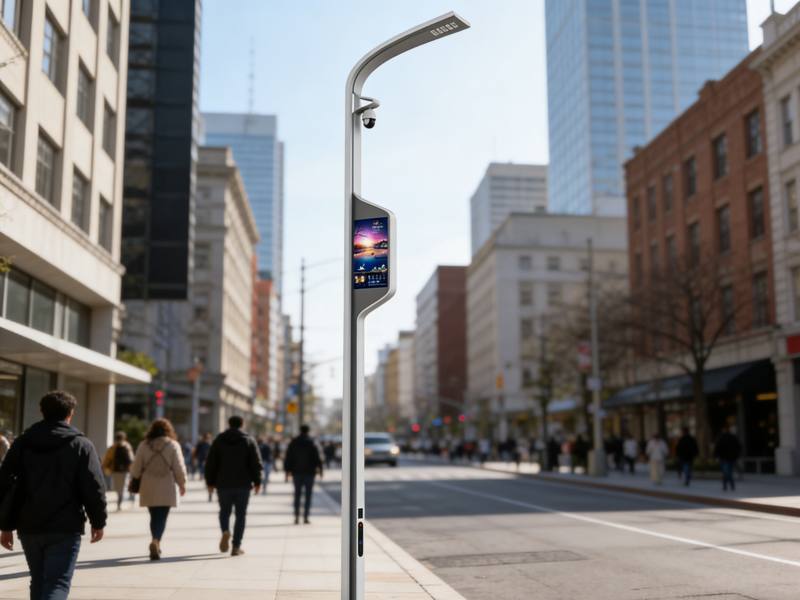
II. Solutions
1. Current Problems
a. Smart light poles are a new type of urban public infrastructure, involving the functions and regulatory responsibilities of government departments in multiple vertical fields such as urban planning, public security, transportation, communications, municipal administration, and environment. They can be shared by multiple departments. Planning and management must be unified and coordinated before smart light poles can be installed, operated, and maintained.
b. A variety of technologies, including the Internet of Things, 5G micro base stations, sensors, cameras, lighting, displays, and charging piles, as well as design, R&D, construction, operation, and maintenance, are involved in the building of urban informatization and 5G micro base stations based on smart light poles. It encompasses a wide range of industries, such as telecommunications operators, construction companies, operating units, system integrators, and different equipment manufacturers. These industries exhibit significant differences and operate independently, failing to form a cohesive industrial force.
c. The realization of the long-term smart functions of smart light poles also requires unified global planning. Dispersed light pole projects will create difficulties for the construction and upgrading of the city-level overall management system and data platform.
2. Construction
a. Smart light poles should be considered an important public infrastructure standard configuration for future cities, integrated into the overall urban development layout. Based on the principles of unified planning, scientific coordination, and intensive construction, a cross-departmental coordination mechanism should be established. This mechanism should comprehensively consider the management and business needs of various departments, combine 5G network deployment, and promote deep co-construction and sharing to reduce and avoid the financial and time costs of redundant construction later.
b. Proactively implement a unified management and operation model, integrating gateway data to effectively break down data silos and achieve interconnectivity of urban operational data, truly realizing intelligent and refined urban management.
c. Aggregate upstream and downstream enterprises in the industry chain to build a sound smart street light industry ecosystem, including equipment manufacturers, system integrators, construction units, operation units, and telecom operators, forming a clustering effect.
TIANXIANG invites you to personalize your unique smart lights! We achieve energy savings of more than 60% by choosing premium LED light sources. We offer fault alerts and on-demand lighting when paired with an IoT remote control system, which drastically lowers operating and maintenance expenses. In order to accommodate various site styles, we encourage customization of appearance color, pole height, and installation technique while striking a balance between functionality and aesthetics.
You will have peace of mind thanks to expert team design solutions and free maintenance during the warranty period. We can design a smart lighting system that meets your needs, whether they are for commercial parks, municipal engineering, or distinctive towns!
Post time: Dec-16-2025