
For municipal lighting projects, conical street light poles are often purchased in several stages. A road may receive its first installation, followed by additional poles three or five years later as nearby areas develop. In other cases, contractors need to replace damaged poles while keeping the original lighting arrangement.
Reordering may appear simple when the previous supplier and product model are known. However, manufacturing specifications, installation conditions, and project requirements can change over time. Ordering poles based only on the original height and appearance may result in products that do not match the existing installation.
Before placing a repeat order, buyers should review several important details to ensure consistency between the old and new batches.
1. Retrieve the Original Approved Drawings
The first step is to locate the final drawings used for the previous order.
An old quotation or product description may contain basic information, such as pole height, material thickness, and surface treatment. However, it may not include every manufacturing detail.
The approved drawings should identify the upper and lower diameters, taper, flange dimensions, access door position, and arm connection details.
It is also important to confirm whether any modifications were made during the original production. Sometimes the final manufactured version differs slightly from the initial quotation because of customer requests or installation adjustments.
Using the final approved manufacturing drawing rather than an early quotation helps prevent these differences from being repeated incorrectly.
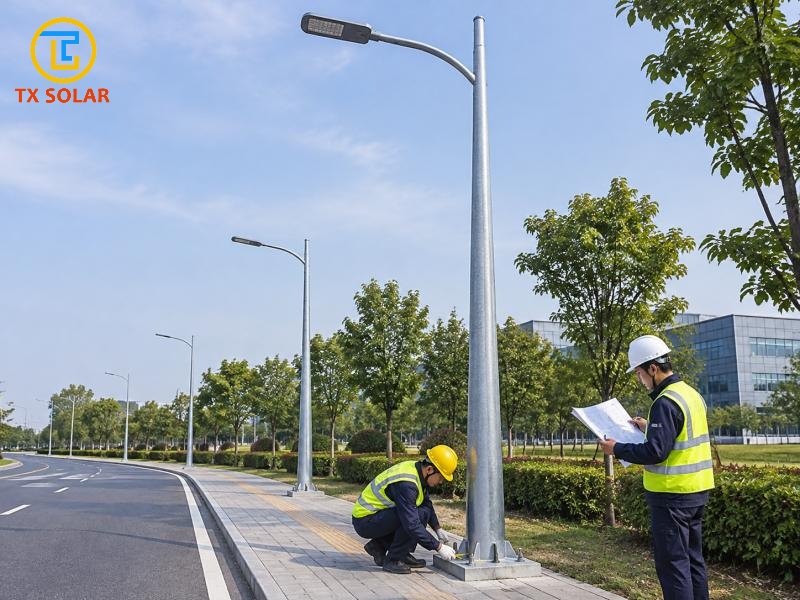
2. Compare the Existing Foundation Connections
Foundation compatibility is particularly important when new conical street light poles will be installed on foundations prepared during an earlier project.
The new conical street pole must match the existing anchor bolt arrangement, including bolt quantity, spacing, hole diameter, and flange orientation.
For example, two conical street poles may both be 9 meters high but have different flange dimensions. If the replacement pole arrives with an incompatible base plate, it cannot be installed directly onto the original anchor bolts.
Buyers should therefore provide the manufacturer with the previous foundation drawing and, when possible, actual site measurements.
Foundation condition must also be assessed separately. Matching bolt dimensions does not automatically mean an existing foundation can safely support a revised pole design.
3. Verify Whether the Lighting Equipment Has Changed
Lighting technology may change significantly between the first purchase and a later order.
The original conical poles may have supported conventional street luminaires, while the new project uses updated LED fixtures with different weights, mounting requirements, or wind-exposed areas.
Even when the conical street pole height remains unchanged, these differences can affect the required structural configuration.
Before reordering, confirm the current luminaire model, weight, projected area, mounting diameter, and lighting arm arrangement.
If the customer intends to reuse the original fixtures, the new pole should be checked for direct mounting compatibility.
If new equipment will be installed, the supplier should evaluate the complete assembly rather than simply reproduce the old pole dimensions.
4. Check the Arm Direction and Access Door Position
Some differences between production batches are difficult to notice until installation begins.
The orientation of the lighting arm and maintenance access door is one example.
For an existing road, the lighting arm must face the intended illumination area, while the access door should remain accessible for electrical maintenance.
If the original poles were manufactured with a specific relationship between the arm, door, and base plate, that arrangement should be clearly identified in the repeat order.
Site photographs can provide useful supporting information, especially when the original drawings do not clearly show orientation.
A simple orientation sketch included with the purchase order can help avoid unnecessary adjustments on site.
5. Match the Existing Surface Finish Carefully
When new poles are installed beside older ones, visual consistency becomes important.
A previous order may have used hot-dip galvanized steel with an additional powder-coated finish. Years later, the buyer may remember only the general color, such as black, grey, or white.
However, a color name alone is not sufficient to reproduce the original appearance.
Buyers should check the previous color reference, gloss level, coating system, and any approved finish sample.
It is also necessary to consider weathering. Poles that have been outdoors for several years may have faded or changed in appearance.
A newly manufactured pole cannot always match the aged surface exactly, even when the original coating specification is repeated.
For projects where appearance is particularly important, an approved new finish sample and a realistic comparison with the installed poles are advisable.
6. Confirm Whether Project Standards Have Been Updated
A repeat order should not automatically follow every technical requirement from the earlier project.
Local regulations, project specifications, wind-load requirements, or customer acceptance standards may have changed since the original installation.
For example, a municipality may now require additional inspection documentation or a different structural design basis.
Before production, confirm whether the previous specification remains acceptable for the new installation.
If requirements have changed, the manufacturer should identify the necessary modifications and obtain approval before manufacturing.
The goal is to maintain compatibility without overlooking current safety and contractual requirements.
7. Review the Original Order Records and New Production Sample
For repeat orders, historical purchase records can provide valuable information beyond the technical drawings.
Useful documents include the previous purchase order, approved sample records, inspection reports, packing lists, and photographs taken before shipment.
These records can help clarify details that may not be visible in a standard product specification.
For larger repeat orders, buyers may also request a first-article inspection or production sample before full manufacturing begins.
The sample should be checked against the updated approved drawing, particularly for critical installation interfaces and visible components.
Any approved changes should be documented so that the remaining poles follow the same requirements.
Conclusion
Reordering conical street light poles years after the original installation requires more than providing the previous model number.
Foundation connections, lighting equipment, arm orientation, surface finish, and project standards should all be reviewed before confirming production.
A successful repeat order should achieve two objectives: maintaining compatibility with the existing installation and meeting the requirements of the current project.
As a professional street light pole manufacturer, TIANXIANG can assist customers in reviewing previous drawings, comparing specifications, and preparing suitable conical pole solutions for project extensions and replacement orders.
Providing complete historical records and updated project information at the inquiry stage can help reduce manufacturing misunderstandings, installation delays, and unnecessary modification costs.
Post time: Nov-13-2026


