
When purchasing LED street lights for municipal roads, industrial parks, or commercial developments, buyers often concentrate on wattage, luminous efficacy, driver brands, and waterproof ratings. However, cable entry design also deserves attention. The cable entry connects the external power supply to the internal electrical system, and its structure can influence installation compatibility, enclosure protection, and long-term operating reliability.
For lighting manufacturers and project buyers, evaluating this detail before confirming an order helps prevent installation difficulties and avoidable maintenance costs. The following points explain what to check when selecting LED street lights.
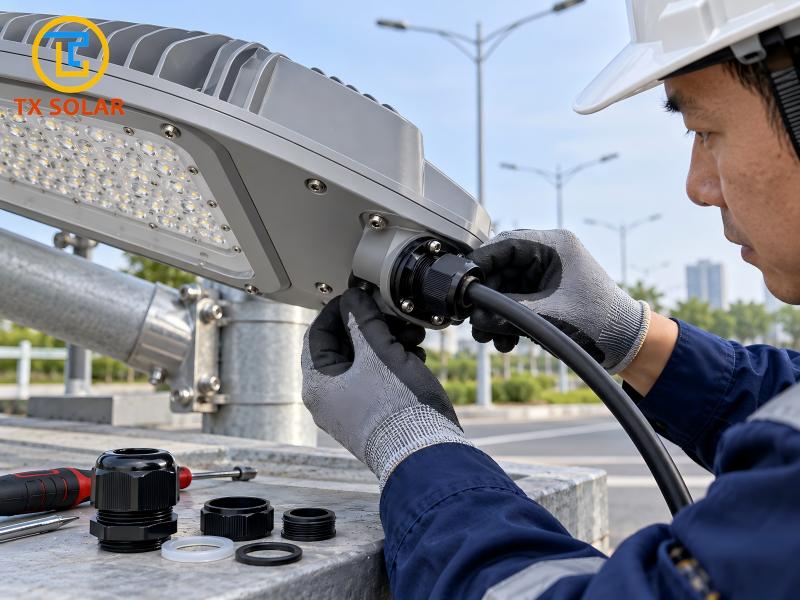
1. Confirm the Cable Entry Type and Position
The first step is to identify how the power cable enters the luminaire. Depending on the design, a street light may use a threaded cable gland, a sealed connector, or another manufacturer-specified cable entry arrangement.
Buyers should confirm the entry position against the product drawing and installation method. The opening must provide enough space for cable routing without interfering with the mounting socket, fastening components, or housing cover.
For side-entry luminaires, particular attention should be paid to the relationship between the cable entry and mounting arm. An unsuitable position may force the installer to bend the cable excessively or make the connection difficult to access. Request a dimensional drawing if the entry location is important to the project installation.
2. Match the Cable Gland to the Actual Cable
A cable gland must accommodate the outside diameter of the specified cable. If the cable is too small for the gland’s sealing range, the connection may not seal correctly. If it is too large, installation can become difficult and may damage the cable sheath.
Buyers should request the gland’s clamping range, thread specification, and compatible cable diameter before approving the configuration. Thread type and size should also match the luminaire housing or designated mounting interface.
Do not assume that a standard gland will suit every project. Different cable constructions and installation requirements may require different fittings.
3. Examine the Complete Sealing Arrangement
Water resistance depends on the complete cable-entry assembly rather than the gland alone. Relevant components may include sealing rings, washers, gaskets, threaded interfaces, and the surrounding housing surface.
Check that the sealing components fit correctly and that tightening the gland will not distort the seal or damage the cable jacket. The design should also prevent sharp edges from contacting the cable insulation.
For outdoor installations, confirm that the supplied assembly supports the required ingress protection. IEC 60529 defines the IP classification system for enclosures, but buyers should verify that the claimed rating applies to the relevant luminaire configuration. Ask for supporting test documentation when the project specification requires it.
4. Check Strain Relief and Internal Cable Routing
The cable entry should secure the cable without transferring excessive pulling forces to internal terminals. During installation and servicing, cables may be moved or pulled, particularly when technicians work at height.
Check whether the gland provides suitable strain relief and whether the internal cable length allows the connection to be completed without excessive tension.
The internal routing should avoid sharp bends, pinched insulation, moving components, and interference with the driver compartment or housing cover. Protective earthing arrangements must also remain intact where required by the luminaire’s electrical protection class. Electrical connections should be checked by qualified personnel according to the applicable product requirements.
5. Consider Environmental Conditions and Material Durability
Cable-entry components operate in the same outdoor environment as the luminaire. Temperature fluctuations, moisture, ultraviolet exposure, vibration, and coastal conditions can affect material performance.
Buyers should ask about the materials used for glands and seals and whether they are suitable for the intended operating environment. Metal fittings may require appropriate corrosion resistance, while elastomeric seals should retain their sealing function under the specified conditions.
For projects in demanding climates, relevant material specifications and environmental test evidence can help buyers compare alternative designs.
6. Confirm Installation and Maintenance Compatibility
A technically suitable cable entry should also be practical for installers. Check whether the gland can be accessed with ordinary installation tools and whether sufficient working space is available around the connection.
For large projects, confirm whether the supplied gland and cable arrangement match the contractor’s installation method. If replacement cables or alternative connectors may be required in the future, discuss compatibility before production.
Any proposed changes to the cable, gland, or enclosure opening should be reviewed by the manufacturer rather than improvised on site.
7. Request Clear Technical Documentation
Before bulk purchasing, request the relevant assembly drawing, cable diameter range, gland specifications, wiring instructions, and applicable ingress-protection evidence. Confirm that these documents correspond to the actual product model and supplied configuration.
During sample approval, record any agreed cable-entry requirements. This gives both the buyer and manufacturer a clear reference for subsequent production.
Conclusion
LED street light cable entries are small components with an important role in installation compatibility, enclosure protection, and electrical reliability. By checking entry position, gland dimensions, sealing materials, strain relief, environmental suitability, and technical documentation, buyers can make more informed purchasing decisions.
Before placing a bulk order, discuss your cable specifications and installation requirements with TIANXIANG. Confirming these details early helps ensure that the selected LED street light configuration is suitable for the intended project.
Post time: Oct-23-2026


