
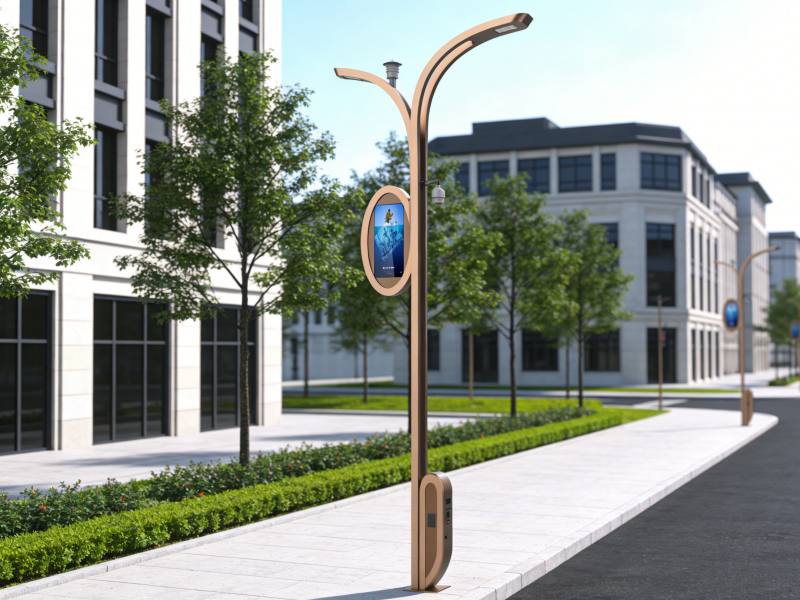
A new generation of infrastructure is represented by smart lighting poles in the development of smart cities. With the development of smart city construction, traditional streetlight poles now serve new purposes. Cutting-edge information technologies like cloud computing, big data, and the Internet of Things are used to integrate sensor devices into smart streetlights. To what extent can a smart streetlight currently support the number of sensor devices? Let us investigate with smart street light solutions provider TIANXIANG.
There is variety in sensors. As of right now, there are roughly three types of sensors that can be installed on smart streetlight poles:
Environmental/Meteorological Monitoring
Motion Detection and Pole Detection
Customized sensors can be added according to actual needs.
I. Environmental/Meteorological Sensors
1. Environmental Monitoring
Real-time monitoring of pollution sources and other local data can be accomplished by mounting environmental monitoring equipment on smart streetlight poles. The interfaces set aside on the smart streetlight poles can be used to install a variety of environmental modules or devices. All monitoring modules support remote centralized management and control, meeting the functions of monitoring and querying the operating status of each monitoring module.
2. Meteorological Monitoring
By installing small weather stations on smart light poles, real-time monitoring of information such as temperature, humidity, wind speed, wind direction, air pressure, rainfall, visibility, ultraviolet radiation, road surface temperature, and water accumulation can be achieved within the area. Various meteorological monitoring equipment can also be mounted using the pre-reserved interfaces on the smart light poles.
II. Motion Detection Sensors
Infrared and microwave radar sensors are currently the two primary categories of motion detection sensors.
1. Infrared Sensors:
Using a repeatable triggering technique, infrared sensors mounted on smart light poles are able to identify human movement.
2. Microwave Radar Sensors:
Microwave radar sensors installed on smart light poles can detect any movement of people, cars, or moving objects by using a repeatable triggering technique. It has a transmitter and a receiver and is based on the 24GHz ISM high-frequency millimeter wave. It detects moving objects using the Doppler frequency shift principle. The 24GHz millimeter wave band is widely available for use throughout the world and operates steadily in a variety of weather, temperature, and brightness conditions. There are also other possible frequency bands, including 58GHz, 60GHz, and 77GHz.
III. Light Pole Detection Sensors
1. Water Immersion Detection Sensor.
Water immersion sensors are required in certain locations, such as low-water areas or cities with high rainfall, to stop needless losses brought on by excessive water accumulation.
2. Tilt Detection Sensor.
By installing tilt sensors on smart city street lights, the tilt of the pole and its tilt angle can be detected. Changes in the static gravitational field are converted into changes in tilt angle, and the horizontal tilt angle value is directly output digitally.
3. Leakage Current Detection Sensor.
To strengthen electrical safety management, promptly eliminate safety hazards, prevent electrical accidents, and protect people’s lives and property, leakage current detection sensors can be added. These sensors collect current signals through a smart gateway, analyze the data, and promptly report leakage current alarms to management personnel.
Lastly, TIANXIANG would like to state that the Internet of Things era is not far off and that sensors will become more prevalent in our lives in the future. In the upcoming generation of infrastructure construction, smart lighting poles will serve as a medium for human-to-human and human-to-object interaction.
Post time: Feb-04-2026