
A smart industrial park generally refers to a group of standard buildings or building complexes planned and constructed by the government (or in cooperation with private enterprises), possessing complete and rationally laid-out water, electricity, gas, communication, roads, warehousing, and other supporting facilities, capable of meeting the needs of specific industry production and scientific experiments. This includes industrial parks, industrial zones, logistics parks, urban industrial parks, science and technology parks, and creative parks.
Purpose of building smart industrial parks
When developing smart industrial parks, the main goal is to achieve highly integrated management. The goal of smart industrial park construction is to obtain a comprehensive, timely, and thorough perception of everything within the park and to centrally manage these elements in a visualized manner in order to achieve efficient and sustainable development.
Cloud computing, big data, artificial intelligence, the internet, GIS (Geographic Information System), and the IoT are all used to power the park’s intelligent streetlights. To integrate information resources within the park, infrastructure platforms like geographic information systems and broadband multimedia information networks must be developed. The park creates information systems for attendance, electronic patrols, access control, parking, elevator control, visitor registration, e-government, e-commerce, and labor and social insurance by looking into the operational status and management requirements of different businesses and organizations. The park’s economy and society are progressively becoming more digital through the sharing of information resources. Concurrently, with the park’s industries at its center, it promotes the idea of applying scientific and technological methods to address real-world issues in the park, investigating the development of the park’s service system, expediting implementation, attaining transcendence and improvement, and raising the park’s degree of development. Collecting various types of data is a critical step in creating a smart industrial park. In addition to lighting, the park’s streetlights now act as a communication link between park operations and the centralized management platform.
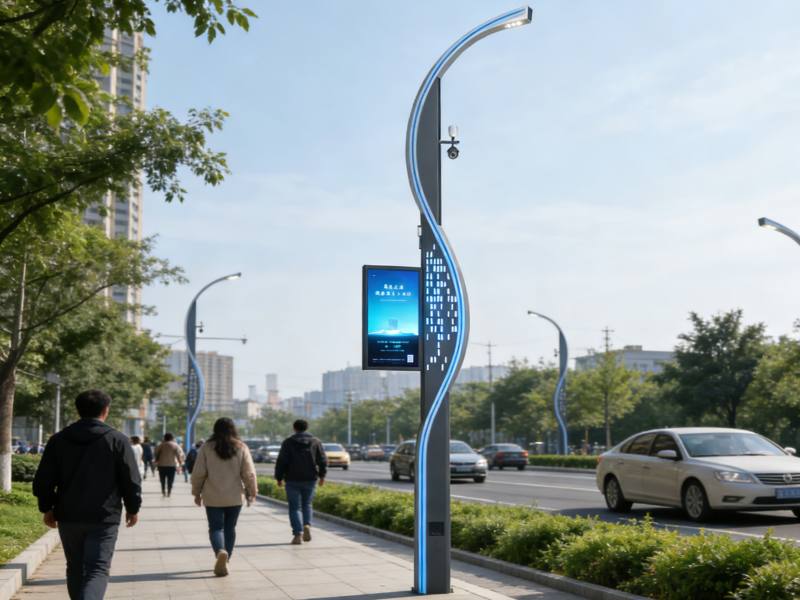
Smart light pole solutions for industrial parks primarily address the following issues:
1. Smart light poles are capable of generating security alerts, video facial recognition, and vehicle facial recognition. They fully meet the requirements of smart industrial parks for visitor identity verification in areas such as attendance, access control, network access, and security monitoring due to their contactless, intuitive, and concurrent design.
2. Early warning of malfunctions and accidents (light fixture failure, leakage, tilt alarms).
3. Clear and efficient daily maintenance (integrated with the existing smart industrial park system).
4. Scientific decision-making for lighting management (light control, time control, latitude and longitude control; real-time monitoring of lighting rate, failure rate, and power consumption), remote management of lighting strategies, remote control via mobile phone or computer, on-demand lighting, secondary energy saving, and a comfortable working environment in the park.
5. The smart light poles include an environmental sensing subsystem that is strong, cohesive, and visually appealing. Centralized monitoring is available for the park’s temperature, humidity, air pressure, wind direction, wind speed, rainfall, radiation, illumination, UV radiation, PM2.5, and noise levels.
TIANXIANG is a well-known smart lighting pole factory. Our poles are made of high-quality steel that is corrosion resistant and easy to maintain thanks to the powder coating and hot-dip galvanizing processes. Pole heights and function combinations can be customized to meet industrial park security, energy efficiency, and intelligent management requirements.
Post time: Dec-23-2025