
As the core infrastructure and “nerve endings” of smart communities, smart poles are far more than a simple upgrade of traditional streetlights. Their construction and deployment must closely align with the living needs of community residents, the efficient operation and maintenance of property management, and the macro-level requirements of refined urban governance. Below, TIANXIANG will discuss the construction of smart communities based on smart poles.
First, let’s understand the concept of a smart community based on smart poles. In the process of urban development, streetlights can be fully utilized as carriers in urban infrastructure, resource environment, social welfare, economic industries, and municipal governance. Through the use of next-generation information technologies such as artificial intelligence, cloud computing, and big data analysis, the activities of urban residents in their lives, work, business development, and government administration can be intelligently sensed, collected, integrated, analyzed, and specifically managed. This will provide citizens with a better living and working environment, create a more favorable business development environment for enterprises, and build a more efficient urban operation and management environment for the government, achieving an overall effect of safety, convenience, efficiency, and green development.
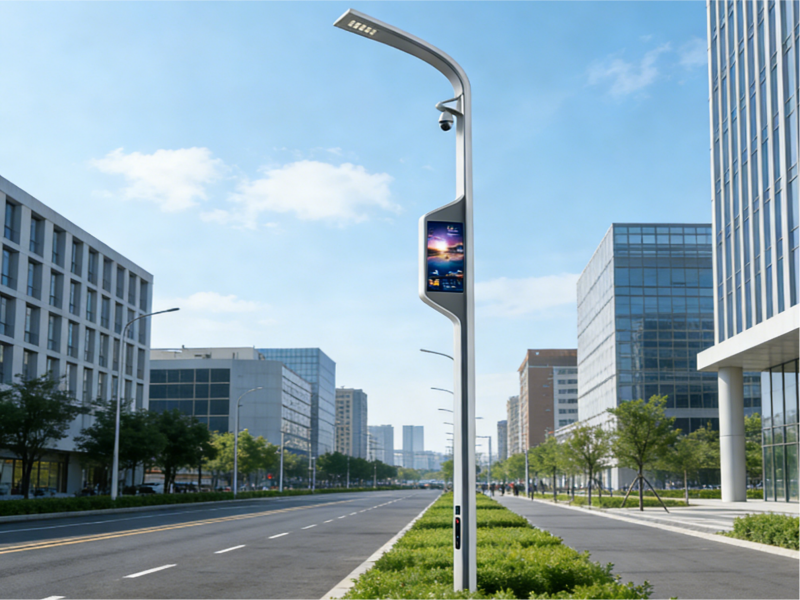
Next, we need to define the positioning of smart community development, which mainly includes three points:
a) Focusing on meeting the needs of people’s livelihoods;
b) Optimizing urban management and services;
c) Improving the quality of life for citizens.
In the process of urban development, these three points can be considered the three primary focal points of smart community construction, and they form the basis of its construction. In order to enable more intelligent community lighting, security, and information sharing, the construction of smart poles in communities aims to fully utilize their scalability. It also provides convenient deployment points for the later construction of 5G micro base stations, effectively implementing the integration of multiple poles into one in terms of policy. Furthermore, since smart poles can be equipped with charging piles, weather instruments, and other equipment, they can enable intelligent management of community parking and charging, and provide accurate, 24/7 monitoring of community roads and surrounding facilities.
Finally, regarding the future development trend of smart communities, we will rely on the application of next-generation information technologies such as cloud computing, the Internet of Things, big data, and mobile internet to integrate smart lighting, mobile communication, Wi-Fi, security management, public infrastructure monitoring, information dissemination, facial recognition, broadcasting, and other information infrastructure into smart light poles in the community. As a result, a smart community with intelligent early warning systems, intelligent management, and intelligent security networks will be created. In order for the overall intelligence level of the smart community to be continuously enhanced and improved with the development and advancement of technology, the system design of smart light poles in the community must fully take into account the advancement, rationality, scalability, and compatibility of the overall intelligent system.
Smart communities, also known as “communities of the future,” will be built and developed in the future, enabling locals to witness the real transformations brought about by technology. Let’s see what happens!
Post time: Jan-21-2026