
As smart city projects continue to develop, LED street lights are no longer designed only for basic illumination. More and more road lighting projects require flexible brightness control, energy-saving operation, and intelligent management. However, achieving the expected lighting performance depends not only on the LED fixture itself but also on whether the dimming requirements are clearly defined before production.
For street light manufacturers, receiving complete dimming specifications at the early stage of a project helps ensure that the final product matches the application requirements, control system, and installation environment.
Why Dimming Requirements Should Be Defined Before Manufacturing
LED street light dimming can provide multiple benefits, including reduced energy consumption, improved operational efficiency, and extended component lifespan. By adjusting light output according to different periods, traffic conditions, or environmental requirements, cities can maintain sufficient illumination while avoiding unnecessary power usage.
However, unclear dimming requirements may create problems during production or installation. For example, the selected driver may not support the required control method, the dimming range may not meet expectations, or the street light may not integrate properly with the existing smart control system.
Therefore, confirming all dimming details before manufacturing is an important step in delivering a reliable lighting solution.
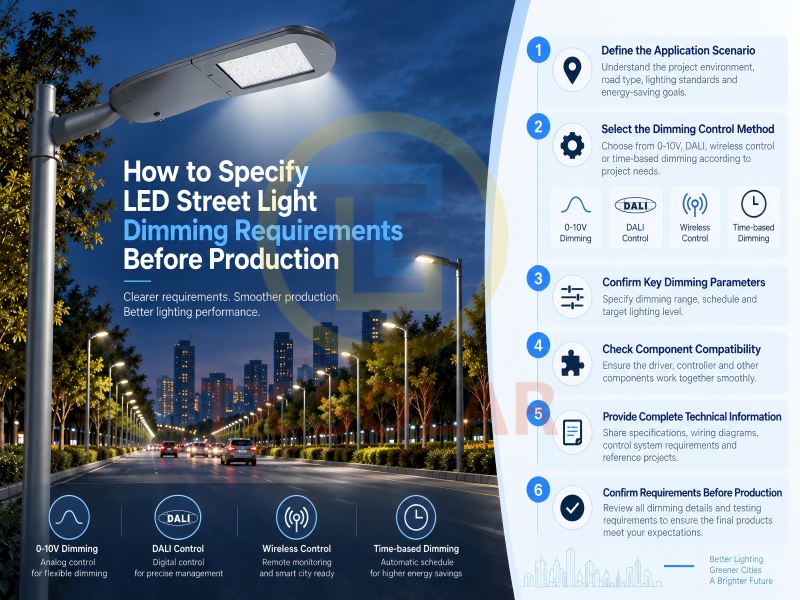
1. Define the Application Scenario
The first step is understanding where the LED street lights will be installed and how they will be used.
Different applications require different lighting strategies. Urban roads, highways, residential streets, parking areas, and industrial zones may have different requirements for brightness levels and operating schedules.
Before production, customers should provide information such as:
Road type and lighting environment
Required working hours
Traffic flow characteristics
Local lighting regulations
Expected energy-saving targets
This information helps manufacturers recommend suitable dimming solutions and configure the lighting system correctly.
2. Select the Appropriate Dimming Control Method
The dimming method is one of the most important specifications that should be confirmed before production.
Common LED street light dimming solutions include:
0-10V dimming: A widely used analog control method suitable for simple brightness adjustment.
DALI control: A digital communication system that allows more precise lighting management.
Wireless control: Suitable for smart city applications requiring remote monitoring and management.
Time-based dimming: Adjusts brightness according to preset schedules.
Each method has different requirements for drivers, controllers, and communication systems. Selecting the correct solution in advance helps avoid compatibility issues during installation.
3. Confirm Key Dimming Parameters
Besides choosing the control method, detailed operating parameters should also be specified before manufacturing.
Important parameters include:
Dimming Range
Customers should define the expected brightness adjustment range, such as reducing output from 100% to a lower level during low-traffic periods.
Dimming Schedule
The project should clarify when brightness changes should occur, whether based on fixed time periods, traffic conditions, or environmental sensors.
Target Lighting Level
Different roads require different illumination levels. The dimming strategy should maintain safe visibility while achieving energy savings.
Clear parameters allow manufacturers to configure the LED driver and control system more accurately.
4. Check Compatibility Between Components
An LED street light is a complete system consisting of multiple components, including the LED module, driver, dimming interface, controller, and communication devices.
Before production, manufacturers should verify that:
The LED driver supports the selected dimming protocol
The control system can communicate correctly
The dimming performance is stable across the required range
Other electrical components meet project requirements
Early compatibility checks reduce modification costs and improve project reliability.
5. Provide Complete Technical Information
Clear communication between customers and manufacturers is essential for successful production.
Customers are encouraged to provide:
Technical specifications
Control system requirements
Wiring diagrams
Reference projects
Installation conditions
The more detailed the information provided before manufacturing, the easier it is for the manufacturer to create a suitable lighting solution.
6. Confirm Requirements Before Mass Production
Before starting production, all dimming-related details should be reviewed and confirmed.
A final confirmation should include:
LED driver model
Dimming method
Control interface
Brightness adjustment range
Operating schedule
Testing requirements
This final review ensures that the manufactured LED street lights meet both technical expectations and project goals.
Conclusion
Defining LED street light dimming requirements before production is an essential part of modern lighting projects. Proper planning helps achieve better energy efficiency, stable performance, and easier integration with intelligent control systems.
As an experienced LED street light manufacturer, TXZM focuses on providing customized lighting solutions based on different project requirements. By working closely with customers during the design and production stages, TXZM helps ensure every lighting system delivers reliable performance and long-term value.
Post time: Oct-16-2026


