
LED street lights play an important role in improving nighttime visibility and road safety. However, when a roadway is located close to residential buildings, poorly controlled lighting may shine through bedroom windows, illuminate private gardens, or create unwanted brightness around balconies. For municipalities, contractors, and lighting project buyers, reducing light spill is an important part of designing comfortable and responsible outdoor lighting systems.
Light spill occurs when light reaches areas outside the intended illumination zone. Unlike glare, which relates to visual discomfort caused by excessive brightness, light spill can affect residents even when they are not looking directly at the luminaire. The following measures can help reduce this problem without compromising necessary road illumination.
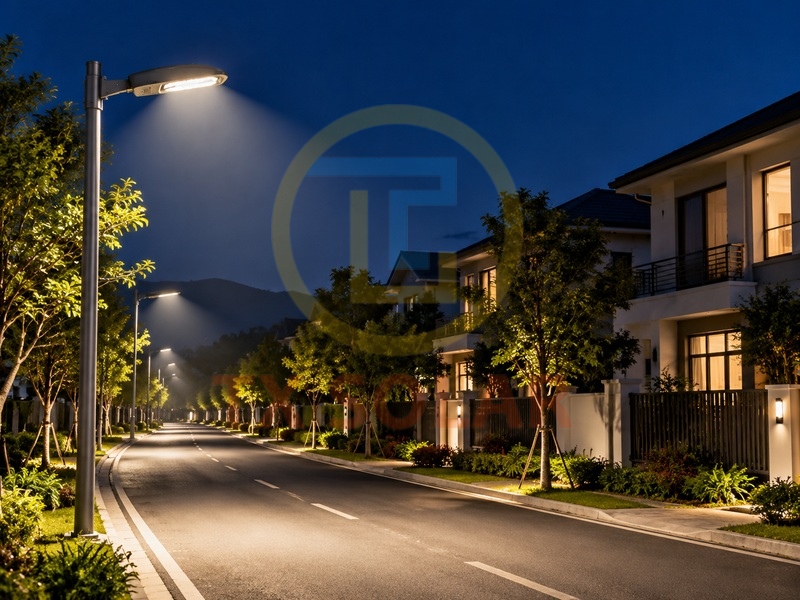
1. Select the Right Optical Distribution
Optical distribution is one of the most important factors affecting light spill. LED street lights with different lens configurations can direct light over different distances and widths. If the distribution is too wide for a narrow residential road, unnecessary light may reach nearby windows, gardens, and building facades.
Buyers should select luminaires according to road width, pole position, mounting height, and the distance between the roadway and nearby homes. Asymmetrical optics may help direct more light toward the road while limiting unnecessary illumination behind the pole or toward adjacent properties.
Before selecting a fixture, review its photometric distribution curve and IES file rather than relying only on wattage or total lumen output.
2. Control Luminaire Orientation and Installation Angle
Even a well-designed LED street light can produce unwanted light spill if it is installed at an unsuitable angle. Excessive upward tilting may send more light toward building windows and increase high-angle light emission.
Installers should follow the manufacturer’s recommended mounting configuration and adjust the luminaire to suit the actual road layout. The light should be directed toward the intended roadway rather than toward residential facades.
Pole position and outreach arm length should also be considered. In some locations, adjusting the pole arrangement or mounting direction can reduce light entering nearby homes more effectively than simply lowering the lamp’s power.
3. Consider Shields and Cut-Off Structures
Where residential buildings are particularly close to the road, shielding may provide an additional solution. Suitable shields, visors, or cut-off structures can block light traveling toward specific windows or neighboring properties.
However, shielding must be compatible with the luminaire’s optical design. An unsuitable shield may create dark areas on the road, reduce lighting uniformity, or interfere with heat dissipation if it is not designed for the fixture.
Buyers should therefore discuss shielding options with the manufacturer and verify the resulting light distribution before approving modifications for mass production.
4. Avoid Excessive Brightness
Higher wattage does not automatically mean better road lighting. An unnecessarily powerful fixture may increase illumination on the road while also sending more light into surrounding residential areas.
The appropriate output should be determined by the road classification, traffic conditions, pedestrian activity, and applicable local requirements. Selecting suitable optics and optimizing pole spacing can often improve light utilization without increasing power.
For projects that support dimming, scheduled output reduction during periods of lower activity may also help. Any dimming strategy must maintain the required lighting performance and comply with project specifications.
5. Evaluate Residential Windows During Lighting Design
Lighting design should consider not only the road surface but also nearby windows and property boundaries. Professional simulation software such as DIALux can help designers assess illumination levels at sensitive locations and identify areas where excessive light may occur.
For residential projects, designers should examine the relationship between pole locations, window heights, building setbacks, and luminaire distribution. Where necessary, calculations can be supplemented by on-site measurements after installation.
The International Commission on Illumination’s CIE 150:2017 guidance addresses obtrusive light from outdoor lighting installations and provides a useful reference for evaluating residential lighting impacts. Applicable limits should be confirmed against local regulations and project requirements.
6. Verify the Results After Installation
A lighting design should be checked under actual operating conditions. Nighttime inspections can reveal light entering windows, unexpected bright spots on facades, and differences between simulated and installed performance.
If residents report excessive brightness, first identify the source and direction of the unwanted light. Adjusting orientation, applying compatible shielding, changing output settings, or revising the optical configuration may help resolve the problem.
Any adjustment should be followed by checks to ensure that road visibility and required illumination levels remain acceptable.
Conclusion
Reducing light spill from LED street lights near homes requires more than choosing a lower-wattage fixture. Appropriate optical distribution, correct installation angles, suitable shielding, balanced brightness, and careful lighting simulation all contribute to better results.
For residential road projects, buyers should communicate nearby building locations and light-spill concerns to the manufacturer before production. This allows the luminaire configuration to be evaluated early, helping balance road safety, energy efficiency, and residents’ nighttime comfort.
Post time: Oct-23-2026


