
The octagonal conical lamp poles have sharp edges and a conical shape, which means that the edges are under concentrated force during stacking and packaging. Compared to round poles, they are more prone to zinc layer peeling or edge indentation. Many manufacturers focus on the large surface of the pole body but overlook the eight edges, which are the first to get damaged. Based on the packaging practices of our factory for both export orders and domestic engineering projects over the years, we will discuss some targeted measures.
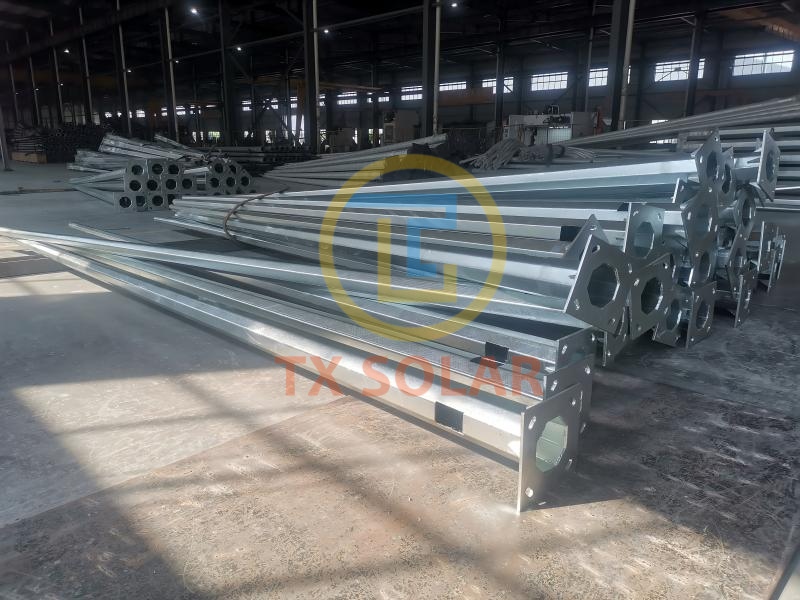
Protect the edges separately to prevent the zinc layer from “directly colliding”
The edges of the octagonal pole are the weakest attachment points for the zinc layer. When two octagonal tapered poles are pressed against each other edge to edge, the vibration during transportation is sufficient to cause zinc layer spots. During packaging, flexible protective strips should be attached to each of the eight edges of the pole. The material can be EVA foam or high-density felt, and the width should be appropriate to fully cover the arc surface of the edge. If the poles are bundled, the poles should not be merely tightened by the binding tape; rubber strips or soft wood padding should be placed on the contact surface. There is a patent document stating that using a moderately hard rubber strip as the gap medium between octagonal conical lamp pole pieces can not only provide friction positioning but also allow for slight relative displacement to absorb impact, which is less likely to damage the edges than rigid wooden blocks.
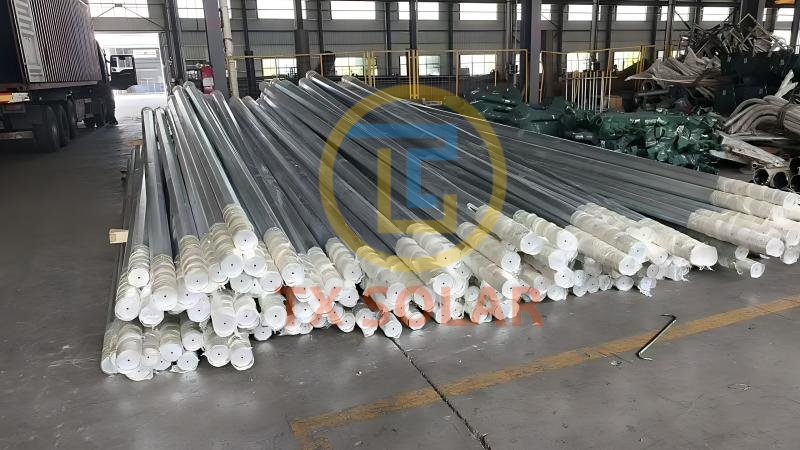
Stack in an alternating direction of the cone to avoid concentrated force on the edges
The octagonal tapered pole has a thick end and a thin end. When stacked in the same direction, all the thick ends weigh on the same side, while the thin ends’ edges are suspended and lifted. This is where the first impact occurs during loading and unloading. When loading or packing, adjacent poles should be placed with the cone directions reversed and alternating so that the thick ends and thin ends bear the weight alternately. This way, the center of gravity of the entire bundle is evenly distributed, and the edge areas will not deform due to concentrated stress. If using iron frames or wooden supports for fixation, the contact surface of the supports should be padded with rubber sheets; it is strictly prohibited for the pole edges to directly rest on hard crossbeams.
Double-layer protection for the end flanges and hand hole positions
The edges of the octagonal pole’s flange and hand hole are high-risk areas for edge damage. The zinc layer at the welding point of the flange is prone to being scratched by the steel wire rope during lifting. It is recommended to first use hard cardboard or plastic guard strips to hold the four sides of the flange, and then wrap the outer layer with felt. The edges around the hand hole cover also need to be protected to prevent deformation from being squeezed by the flanges of adjacent poles. After packaging, wooden end sleeves or thick corrugated paper protective sleeves should be added at both ends of the bundle to completely cover the edge corners. The fork will not hit the octagonal tapered pole body when inserted.
Post time: Nov-26-2026


