
When purchasing octagonal street light poles for a road lighting project, buyers often focus on pole height, material thickness, wind resistance, and surface treatment. However, the foundation is another important part of the overall installation that should be considered before manufacturing begins.
A properly designed foundation provides the structural support needed to transfer loads from the street lighting pole into the ground. If the foundation dimensions, anchor bolt arrangement, or base plate specifications do not match the pole design, contractors may encounter installation delays, additional construction costs, or structural problems.
For this reason, foundation planning should begin during the quotation and engineering confirmation stage rather than after the street lighting poles have been manufactured. The following considerations can help buyers prepare a suitable foundation plan for octagonal street light poles.
1. Confirm the Pole Specifications Before Designing the Foundation
The first step is to establish the complete specifications of the octagonal street light pole.
Foundation dimensions cannot be determined by pole height alone. Two poles with the same height may require different foundations because of differences in structural configuration and external loading.
Before requesting a foundation drawing, buyers should confirm:
Total pole height and installation method.
Upper and lower across-flats dimensions.
Pole wall thickness and steel grade.
Single-arm, double-arm, or multiple-arm configuration.
Luminaire weight and projected wind area.
Additional equipment, such as solar panels, cameras, or signs.
Design wind speed and applicable structural standards.
These details help the engineering team determine the loads transferred through the pole base.
For example, an 8-meter octagonal pole supporting one compact LED luminaire may have different foundation requirements from an 8-meter pole carrying two luminaires and additional equipment.
The complete pole assembly should therefore be evaluated before the foundation dimensions are finalized.
2. Determine the Required Foundation Type
Octagonal street light poles are commonly installed using either a flange-mounted foundation or a direct-buried arrangement.
Flange-mounted installation
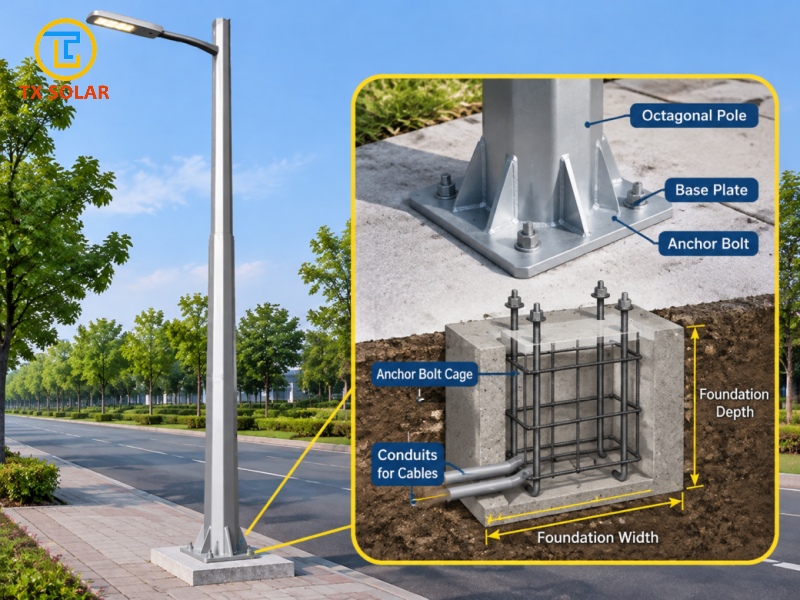
This is a widely used method for galvanized steel street light poles. The pole has a welded base plate with bolt holes, which connects to anchor bolts embedded in a reinforced concrete foundation.
Its main advantages include:
Convenient installation and replacement.
Easier adjustment of pole verticality.
Clear separation between foundation construction and pole manufacturing.
Better accessibility for inspection and maintenance.
Direct-buried installation
In this arrangement, the lower part of the pole is inserted into the ground or a prepared foundation structure according to the approved design.
This approach may be suitable for certain road lighting applications, but the buried section requires appropriate corrosion protection and structural verification.
The choice should depend on the project requirements, soil conditions, maintenance expectations, and local construction practices.
For projects requiring easier future replacement, flange-mounted installation is often a practical option.
3. Match the Base Plate and Anchor Bolt Arrangement
One of the most important tasks before ordering an octagonal street light pole is confirming the compatibility between its base plate and the foundation anchor bolts.
The base plate transfers the forces acting on the pole into the anchor bolt assembly and concrete foundation. Any mismatch can create serious installation difficulties.
The following dimensions should be confirmed between the pole manufacturer and the foundation designer:
Base plate dimensions: Confirm the plate’s length, width, shape, and thickness according to the approved structural design.
Anchor bolt quantity: Determine the required number of anchor bolts and their arrangement.
Bolt circle or bolt spacing: Check the center-to-center distance between anchor bolts and ensure that it matches the base plate hole positions.
Anchor bolt diameter and grade: These should be selected according to the calculated forces and applicable engineering requirements.
Anchor bolt projection: Confirm the exposed threaded length required for installing nuts and washers after concrete placement.
For octagonal poles, the orientation of the base plate and its bolt pattern should also be clearly indicated in the manufacturing drawings.
A mismatch between the anchor bolt template and the finished base plate may require costly modifications on site. It is much easier to identify these problems before the concrete is poured.
4. Consider Soil Conditions and Local Environmental Factors
The foundation must be designed for the actual ground conditions rather than based on a standard dimension copied from another project.
Different soil types have different bearing capacities, settlement characteristics, and resistance to lateral loads.
For example, compacted soil, loose sand, soft clay, and reclaimed land can require different foundation arrangements.
Other factors should also be reviewed:
Groundwater level and seasonal water fluctuations.
Soil erosion and possible ground movement.
Frost depth in cold regions.
Seismic conditions where applicable.
Coastal exposure and soil corrosion.
Nearby drainage systems and underground utilities.
A geotechnical investigation can provide useful information about the soil profile and its engineering properties.
The foundation designer should use this information together with the pole manufacturer’s structural load data to determine the appropriate foundation dimensions, reinforcement, and embedment depth.
There is no universally suitable foundation size for every octagonal street light pole.
5. Coordinate Cable Conduits and Foundation Orientation
Electrical arrangements should also be considered before foundation construction.
Street light poles generally require underground cable connections through conduits installed within or beneath the concrete foundation.
The conduit position should be coordinated with the pole’s base plate, cable entry, and access door.
For example, if the access door is positioned on a particular side of the pole, the internal cable arrangement should allow convenient connection and future maintenance.
For projects involving multiple poles, maintaining consistent orientation can make electrical installation and maintenance more efficient.
Buyers should confirm:
Cable entry direction.
Conduit quantity and diameter.
Conduit exit position.
Grounding connection requirements.
Access door orientation.
Space required for electrical connections.
These details should be included in the foundation and pole installation drawings to reduce the possibility of on-site adjustments.
6. Check Foundation Height, Drainage, and Finished Ground Level
The relationship between the foundation top and the surrounding ground level is another detail that should not be overlooked.
For flange-mounted poles, the concrete foundation should provide a suitable mounting surface for the base plate and anchor bolt assembly.
The foundation designer should specify the required top elevation, concrete dimensions, and any necessary grout or leveling arrangement.
Water accumulation around the pole base can accelerate corrosion and affect the long-term condition of the installation.
Therefore, the surrounding ground should provide appropriate drainage, especially in areas with heavy rainfall.
For road lighting projects using raised concrete foundations, the exposed concrete height should also be coordinated with the finished pavement or landscape level.
The foundation should not obstruct pedestrian access or create unnecessary obstacles along sidewalks.
7. Prepare a Coordinated Foundation Drawing Before Ordering
Once the main technical details have been confirmed, the next step is to prepare a coordinated drawing showing the relationship between the pole and its foundation.
A useful foundation drawing should include:
Foundation length, width, and depth.
Concrete grade and reinforcement arrangement.
Anchor bolt quantity, diameter, spacing, and embedment details.
Base plate dimensions and bolt-hole positions.
Anchor bolt projection above the concrete surface.
Cable conduit locations and grounding provisions.
Finished ground level and foundation top elevation.
Pole installation direction and access door orientation.
The pole manufacturer’s base plate drawing and anchor bolt template should be checked against the foundation drawing before construction begins.
For projects with special wind conditions or unusual soil characteristics, structural verification should be completed by a qualified local engineer.
This coordination is particularly important for large road lighting projects involving dozens or hundreds of street light poles, where even a small dimensional error can affect multiple installation locations.
8. What Should Buyers Confirm With the Manufacturer?
Before placing an order, buyers should communicate the foundation requirements clearly with the street light pole manufacturer.
The following information is especially useful:
Approved pole dimensions and structural drawings.
Base plate size and thickness.
Anchor bolt layout and specifications.
Foundation design loads or base reactions.
Cable entry and access door arrangements.
Required installation method.
Project wind speed and soil information.
Applicable local engineering standards.
It is also advisable to request the anchor bolt template and related installation drawings early enough for the civil engineering team to review them.
If foundation construction is scheduled before pole delivery, all interface dimensions should be approved in advance.
Conclusion
Planning octagonal street light pole foundations before ordering helps prevent dimensional mismatches, construction delays, and unnecessary project costs. The key is to coordinate the pole specifications, base plate, anchor bolts, soil conditions, electrical arrangements, and foundation drawings as one complete installation system.
Rather than selecting a foundation based only on pole height, buyers should request the necessary structural information and confirm the foundation design with qualified engineers before construction.
As a professional street light pole manufacturer, TIANXIANG provides customized octagonal steel poles according to different project requirements. By confirming foundation interfaces and installation details during the early design stage, buyers can achieve a more coordinated manufacturing and construction process for their outdoor lighting projects.
Post time: Nov-19-2026


