
Long-distance shipping presents several challenges for LED street light manufacturers and international buyers. From factory handling to container loading, street light fixtures may experience repeated movement, vibration, stacking pressure, humidity, and sudden impacts. Without suitable packaging, even a well-manufactured luminaire can arrive with scratched housings, cracked optical covers, bent mounting components, or damaged electrical connections.
For overseas lighting projects, packaging should do more than keep products inside a carton. It should protect sensitive components, simplify warehouse handling, support efficient container loading, and help ensure that every fixture arrives ready for installation.
As an experienced LED street light manufacturer, TIANXIANG recognizes that effective export packaging starts with understanding the product structure, transportation route, and delivery requirements. The following guide explains the key considerations for preparing LED street light fixtures for long-distance shipment.
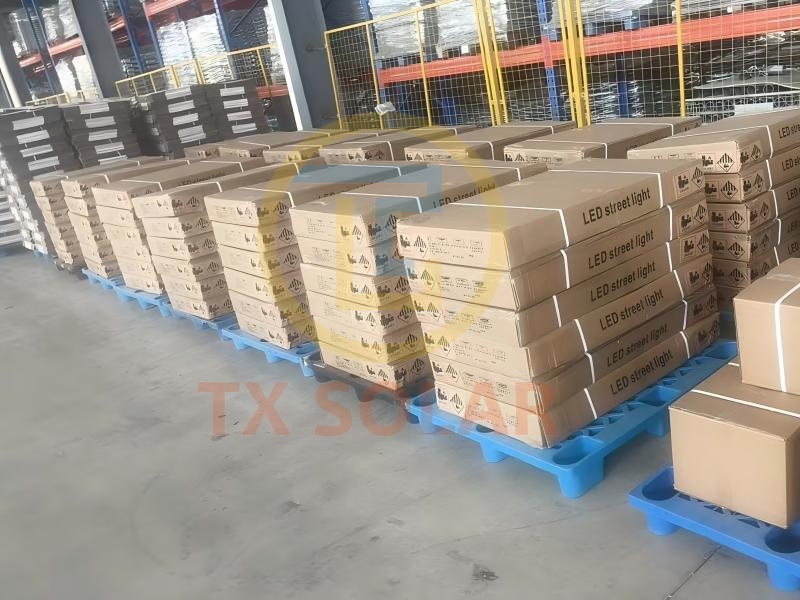
1. Understand the Structure of the LED Street Light Before Packing
The first step is to identify the components that require additional protection. LED street lights commonly combine die-cast aluminum housings, optical lenses or glass covers, LED modules, drivers, mounting sockets, and electrical connection points. Different parts respond differently to pressure and impact during transportation.
Before selecting packaging materials, confirm the fixture dimensions, weight, mounting configuration, and accessory requirements.
The packaging plan should answer three basic questions:
Which components are most vulnerable to impact or abrasion?
Which areas must remain free from pressure during stacking?
Will the fixture be shipped individually, in bulk cartons, or as part of a complete street lighting project?
For customized products, packaging should be designed around the actual model rather than relying on a standard carton that may not provide adequate clearance.
2. Prevent Moisture Problems During Long Sea Freight
Sea freight can expose packages to prolonged humidity and temperature changes. Under certain conditions, moisture can condense inside packaging when temperatures fluctuate between ports, containers, and storage facilities.
This can create problems for metal surfaces, electrical connections, and accessories if the packaging system does not adequately manage moisture.
To reduce the risk:
Use dry packaging materials and ensure fixtures are clean and dry before packing.
Consider suitable moisture-barrier liners for routes and storage conditions that warrant additional protection.
Use compatible desiccants where appropriate, based on the packaging volume, expected transit duration, and moisture-control requirements.
Avoid sealing products while moisture remains on their surfaces.
Store packed goods in a dry area before container loading.
Desiccants are not a substitute for proper sealing or moisture control. Their quantity and placement should be selected for the actual package and transport conditions.
For extended ocean shipments, buyers and manufacturers should also consider container condition, ventilation, loading practices, and the possibility of condensation. A robust carton cannot compensate for a wet container or poor storage conditions.
3. Use a Different Packaging Plan for Complete Street Lighting Projects
A complete street lighting project may include LED fixtures, mounting brackets, poles, cables, control devices, and installation accessories. These products should not automatically be packed using the same method.
Fixtures can be shipped in protective cartons, while long poles may require separate bundling, surface protection, and securing arrangements. Small accessories should be grouped and labeled to prevent them from being lost during unloading or installation.
If fixtures and poles are transported together, ensure that the metal surfaces cannot rub against each other. Contact points should be separated with suitable protective materials, and the load should be secured against movement.
For projects involving multiple fixture models or installation locations, mark each package with useful identification information, such as the product model, quantity, project reference, carton number, and destination where applicable.
Clear identification is particularly valuable when an order is delivered in several containers or distributed to multiple construction sites.
4. Test the Packaging Before Shipping Large Orders
A package that looks secure in the factory may not perform as expected during a long journey. Before adopting a packaging design for a large order, evaluate whether it can protect the fixture under realistic handling and transport conditions.
Depending on the product value, order size, and destination requirements, the evaluation may include:
Visual inspection: Check the carton, inserts, protective films, and internal positioning.
Handling assessment: Confirm that the package can be moved using the intended warehouse equipment without damaging the product.
Stacking assessment: Verify that the carton and pallet arrangement can withstand the planned stacking loads.
Transport simulation: Consider appropriate vibration, shock, or drop testing based on the package’s weight, size, and distribution environment.
Post-test inspection: Open the package and examine the housing, optical cover, mounting interface, accessories, and electrical connections.
Conclusion
Packaging LED street light fixtures for long-distance shipping requires a balance between product protection, moisture management, handling safety, and freight efficiency. The right combination of carton strength, fitted cushioning, component separation, protective materials, and secure loading can significantly reduce avoidable transport damage.
For LED street light manufacturers and international buyers, packaging should be considered an essential part of export preparation rather than the final step after production. By establishing clear packaging specifications and inspecting each shipment before dispatch, both parties can reduce delivery risks and improve project coordination.
TIANXIANG supplies LED street lighting products for international projects and understands the importance of preparing products for overseas delivery. Packaging arrangements can be evaluated according to fixture dimensions, order quantities, transportation methods, and customer requirements.
If you are sourcing LED street lights for a municipal, commercial, or infrastructure project, contact TIANXIANG to discuss your product specifications and export packaging requirements before shipment.
Post time: Oct-10-2026


