
For many buyers, the access door on a conical street light pole looks like a small detail compared with pole height, wall thickness, flange size, or arm length. However, in practical road lighting projects, the access door orientation can affect maintenance safety, cable installation, water resistance, appearance consistency, and even long-term operating convenience.
When the conical pole is already in production, changing the access door direction can be troublesome. That is why the orientation should be discussed before manufacturing rather than after the poles arrive at site. For contractors, consultants, and municipal buyers, choosing the correct door orientation helps avoid unnecessary installation adjustments and maintenance difficulties later.
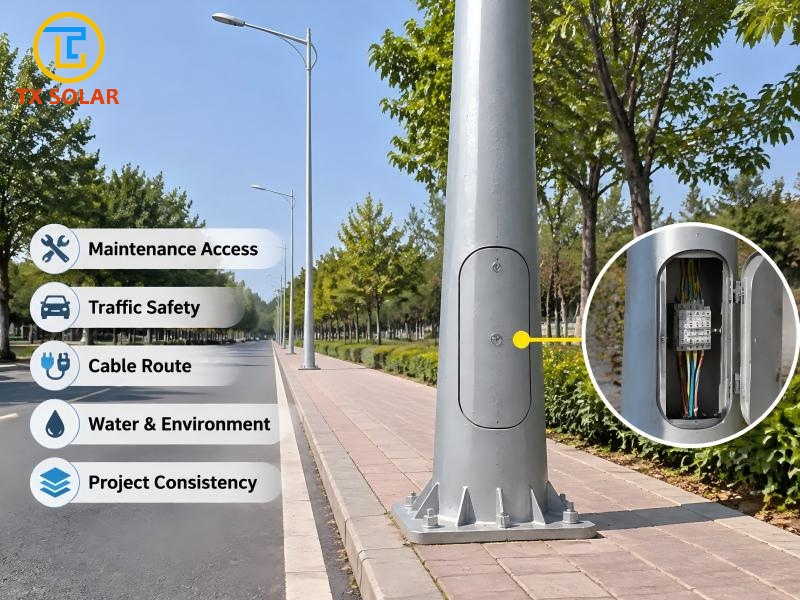
1. Understand the Main Function of the Access Door
The access door is the opening near the lower part of the pole used for wiring, inspection, grounding connection, fuse access, and maintenance of internal electrical components. Because it is located in the lower section of the conical pole, it must be easy enough for technicians to reach, but it also should not create avoidable safety or durability problems.
In other words, the best orientation is not simply the one that looks neat on a drawing. It should support the actual use of the pole throughout its service life.
2. Consider Maintenance Access First
In many projects, the most practical rule is to place the access door on the side that maintenance personnel can reach more safely and conveniently.
For example, if the conical pole is installed along a road with a sidewalk, placing the access door on the sidewalk side can make routine inspection easier than placing it on the traffic side. Technicians can open the door, check the internal wiring, and perform maintenance with less exposure to moving vehicles.
For median installations, the preferred orientation may depend on how maintenance vehicles approach the pole and whether there is a safe working space around the foundation. The orientation should match the real maintenance method, not just the drawing habit.
3. Avoid Unfavorable Traffic Exposure
The traffic side is not always the best side for the access door. If the door opens toward fast-moving traffic, maintenance can become more hazardous. The technician may have limited working space, and tools or removed covers may be exposed to passing vehicles.
For this reason, many projects prefer the access door to face away from the main traffic flow, or toward the side where maintenance can be carried out with better protection. This is especially important on urban roads, highways, and other locations with limited shoulder space.
4. Check the Cable Entry Direction
The access door orientation should also be coordinated with the cable route. If the underground conduit or cable entry comes from a specific direction, aligning the door more conveniently with that route can simplify installation and future servicing.
A poorly chosen door orientation may force awkward cable bending inside the conical lighting pole, reduce working space, or make it harder to inspect and replace electrical parts. For this reason, the pole drawing should be reviewed together with the cable layout, base plate orientation, and anchor bolt arrangement before production approval.
5. Think About Water Drainage and Environmental Exposure
Although the access door is sealed, it is still a sensitive part of the conical lighting pole. Its orientation should avoid unnecessary exposure to standing water, splash zones, or persistent contamination when possible.
In some roadside environments, the curb side may collect more water, mud, or debris. In coastal or industrial locations, one side of the pole may also receive harsher environmental exposure. While the door structure and sealing quality remain critical, orientation can still help reduce long-term risk when combined with good design and proper installation.
6. Keep Appearance Consistent Across the Project
For municipal roads, residential developments, and commercial streetscapes, visual consistency matters. If some poles have access doors facing one direction and others face another, the project may look disorganized, especially when the poles are installed in a visible row.
Therefore, once the correct door orientation rule is established, it should be applied consistently throughout the order unless different installation zones require different arrangements. A clear note on the approved drawing helps prevent production confusion.
7. Confirm Orientation Relative to the Arm and Base Plate
The access door orientation should never be discussed alone. It must be defined relative to the pole arm direction, flange hole pattern, and site installation reference.
For example, the drawing should clearly state whether the access door is opposite the arm, at 90 degrees to the arm, or facing a defined road or sidewalk side. Vague instructions such as “door on one side” are not enough for production control.
A precise drawing note helps ensure that manufacturing, galvanizing, delivery, and site installation all follow the same orientation logic.
Conclusion
Choosing the access door orientation for conical street light poles is a small decision with practical consequences. The correct orientation should support safe maintenance, suit the traffic environment, match cable routing, reduce unnecessary environmental exposure, and maintain a consistent project appearance.
As a professional street light pole manufacturer, TIANXIANG recommends confirming access door orientation during the drawing stage instead of leaving it to site adjustment. A clear orientation note can reduce mistakes, improve maintenance convenience, and help the finished installation perform better over time.
If you are planning a conical street light pole project, send TIANXIANG your road layout, arm direction, and installation conditions so that the pole details can be matched more accurately before production.
Post time: Nov-13-2026


