
When purchasing conical lighting poles, buyers often focus on pole height, wall thickness, and bottom diameter. However, the lighting arm is another important factor that can significantly influence the final pole specifications. Even when two conical poles have the same height, different arm configurations may require different structural designs, connection details, and mounting arrangements.
For road lighting projects, the arm should not be treated as a separate accessory selected after the pole has been manufactured. Its dimensions and configuration should be considered during the initial design stage to ensure that the complete lighting assembly meets the project requirements.
1. Arm Length Influences Structural Requirements
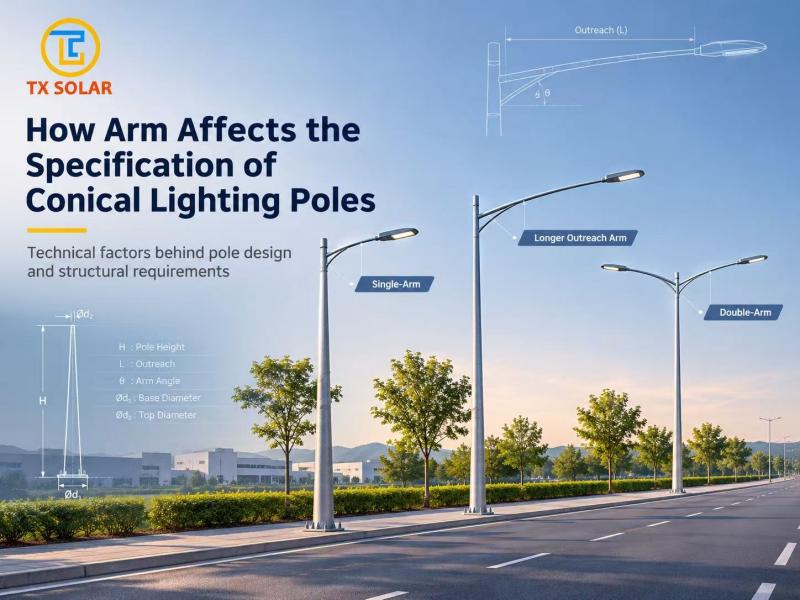
The arm length determines how far the luminaire extends from the center of the lighting pole. A longer arm positions the light farther over the roadway, but it also increases the bending effect caused by the weight of the luminaire and the arm itself.
For example, an 8-meter conical lighting pole equipped with a 0.5-meter arm may have different structural requirements from an 8-meter pole fitted with a 2-meter arm. Even if both poles support the same LED luminaire, the longer arm creates a greater load eccentricity.
Depending on the equipment weight, wind conditions, and structural calculations, a longer arm may require adjustments to the pole diameter, wall thickness, or connection reinforcement.
Therefore, manufacturers should confirm the required arm outreach before finalizing the main pole dimensions rather than assuming that poles of equal height can use identical specifications.
2. Single and Double Arms Create Different Loading Conditions
The number and arrangement of arms also affect the design of conical lighting poles.
Single-arm configurations are commonly used for roadside installations where one luminaire illuminates the adjacent roadway. Double-arm configurations are often selected for central median installations, allowing luminaires to illuminate opposite sides of the road.
However, a double-arm pole is not simply a single-arm pole with an additional bracket.
Two luminaires increase the total equipment weight and exposed surface area. Their positions also influence how loads are transferred through the pole structure.
Although symmetrical arms may balance certain gravitational effects, the assembly must still resist wind forces and other design loads. Unequal arm lengths, different luminaire weights, or asymmetrical arrangements can introduce additional bending and torsional effects.
Consequently, manufacturers should evaluate the complete arm configuration rather than selecting the pole specification based only on the number of lighting fixtures.
3. Arm Angle Changes the Required Mounting Geometry
The angle and shape of a lighting arm influence the final installation position of the luminaire.
Straight arms, upward-inclined arms, and curved arms can place the luminaire at different heights and horizontal positions, even when installed on poles of the same nominal height.
For roadway lighting, these differences can affect the effective mounting height, luminaire orientation, and lighting distribution.
An excessively inclined arm may also create installation difficulties if the luminaire mounting interface does not allow sufficient angle adjustment.
Before production, the arm angle should therefore be coordinated with the luminaire mounting requirements and the project’s lighting design.
This is particularly important when lighting simulations have already established specific mounting heights and fixture positions.
4. Arm Connections Affect the Upper Pole Specification
The connection between the arm and the conical pole deserves particular attention.
Because a conical shaft gradually changes diameter along its height, the connection position must match the actual pole geometry.
For welded arms, manufacturers need to consider weld arrangement, connection strength, and possible local reinforcement. For detachable arms, the connection sleeve, bolts, and fixing dimensions must be compatible with the pole.
A connection designed for one upper pole diameter cannot automatically be transferred to another pole with a different taper.
The luminaire mounting end must also be checked. Its outside diameter, insertion length, and fixing method should match the selected LED street light.
Confirming these dimensions before fabrication helps prevent situations where the pole and luminaire arrive at the construction site but cannot be assembled correctly.
5. Arm Configuration Can Influence Base and Foundation Design
Changes in arm configuration do not affect only the upper section of a conical lighting pole.
Additional arm length, luminaire weight, and wind-exposed area can increase the forces transmitted through the pole to its base connection and foundation.
For flange-mounted poles, engineers may need to review the base plate, anchor bolts, and related structural details.
However, a longer arm does not automatically mean that a thicker flange or larger foundation is required. The final specifications depend on the combined loading conditions and the applicable project design requirements.
For this reason, changing the arm design after approving the original pole drawing may require another structural review.
6. What Buyers Should Confirm Before Production
To avoid specification discrepancies, overseas buyers and project contractors should provide complete arm information when requesting quotations for conical lighting poles.
Important details include:
- Required arm length and horizontal outreach
- Single-arm, double-arm, or customized configuration
- Arm inclination angle and mounting height
- Luminaire weight and wind-exposed area
- Arm-to-pole connection method
- Luminaire mounting diameter and fixing requirements
- Project wind conditions and applicable design standards
These parameters should be clearly indicated on the approved technical drawings.
For customized projects, confirming the complete arm and pole assembly before mass production can reduce installation problems, unnecessary modifications, and project delays.
Conclusion
The lighting arm plays an important role in determining the specifications of conical lighting poles. Its length, quantity, angle, and connection method can influence structural loading, pole dimensions, mounting compatibility, and foundation requirements.
For reliable roadway lighting projects, the arm and pole should be designed as one coordinated assembly rather than treated as independent components.
As a professional street light pole manufacturer, TIANXIANG provides customized conical lighting poles with different arm configurations according to project requirements. By confirming the installation layout and technical parameters in advance, buyers can obtain pole specifications that better match their lighting applications while avoiding unnecessary manufacturing and installation costs.
Post time: Nov-06-2026


