
Both the industry and the market for smart streetlights are expanding. What distinguishes smart streetlights from regular streetlights? How come the prices are so different?
When customers ask this question, TIANXIANG usually uses the difference between a smartphone and a basic mobile phone as an example.
The primary basic functions of a mobile phone are text messaging and making and receiving calls.
Streetlights are primarily used for functional lighting.
A smartphone can be used to make and receive calls, send text messages, access the internet, use a variety of mobile apps, take pictures, record high-definition video, and much more.
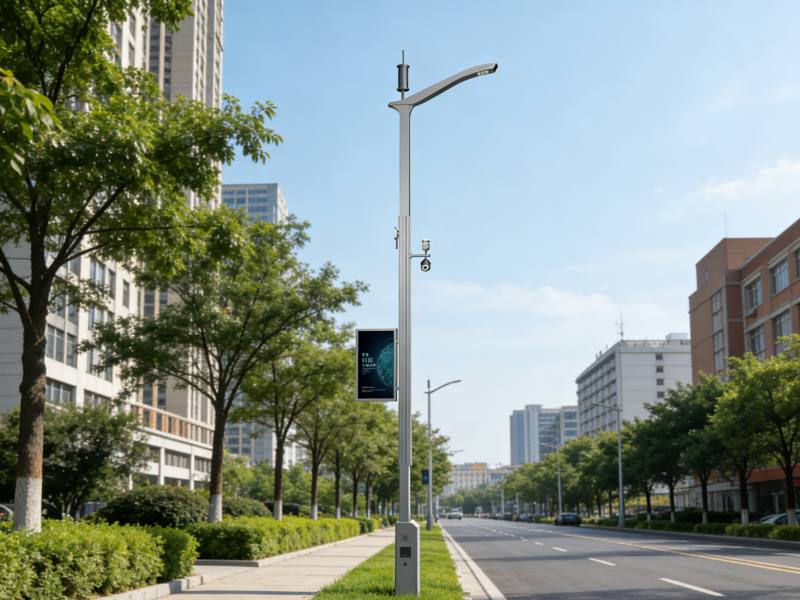
In addition to providing practical lighting, a smart streetlight can collect and transmit data, connect to the internet, and integrate with a variety of IoT devices.
Smart streetlights and smartphones are now much more than just functional lighting devices that can make and receive calls. While the introduction of mobile internet has redefined the traditional mobile phone, the Internet of Things (IoT) in smart cities has given traditional streetlight poles a new purpose.
Second, the materials, construction, systems, functions, manufacturing procedures, and customization needs of smart streetlights are different from those of regular streetlights.
Material requirements: Combining several Internet of Things devices, smart streetlights are a new kind of infrastructure. Steel and aluminum can be combined to create visually appealing and distinctively styled poles that satisfy the customization requirements of different cities due to the high plasticity and expandability of the aluminum alloy, something that conventional streetlights cannot do with their steel materials.
In terms of manufacturing specifications, smart streetlights are more demanding. Because they need to fit a lot of sensors and consider things like weight and wind resistance, their steel plates are thicker than those of standard streetlights. Furthermore, the technology used to interface with the sensors must meet strict requirements.
In terms of functional requirements: Depending on the requirements of the project, smart streetlights can be outfitted with optional features like cameras, environmental monitoring, charging piles, wireless phone charging, displays, loudspeakers, Wi-Fi devices, micro base stations, LED lights, one-button calling, etc. all of which are controlled by a single system platform. The NB-IoT single-lamp controller is the only way to remotely control regular streetlights.
In terms of construction and installation requirements: Smart streetlights require 24/7 continuous power supply for their IoT devices, making them significantly more complex than ordinary streetlights. Pole foundation construction must be redesigned to account for reserved interfaces and load-bearing capacity, and electrical safety control regulations must be tightened.
Smart streetlights typically use a ring network for networking purposes. The device compartment of each pole houses a core gateway for network configuration and data transfer. Regular streetlights do not require this level of complexity; the most common intelligent devices are single-lamp controllers or centralized controllers. About the platform management software that is needed: After data collection and aggregation, the system management platform for smart streetlights must interface with the local smart city platform in addition to fully integrating the protocols between different IoT devices.
Finally, these are the main reasons why smart streetlights are more expensive than regular streetlights. From a hard cost perspective, these are fairly easy to calculate, but from a soft cost perspective, especially in the early stages of industry development, it is difficult to accurately estimate the cost.
When policies are implemented in various areas, TIANXIANG is convinced that smart streetlights, a new type of urban public infrastructure, will create a new environment for smart cities.
Post time: Jan-20-2026