
For many road lighting projects, conical lighting poles are delivered to the construction site before the foundations are ready or the installation schedule is confirmed. As a result, the poles may remain in temporary storage for several days or even weeks.
Although conical lighting poles are designed for outdoor use, improper storage can still cause surface damage, deformation, or missing components before installation begins. These problems may lead to additional inspection work, coating repairs, and unexpected construction delays.
For contractors and project purchasers, proper storage management is an important step in protecting the condition of delivered lighting poles.
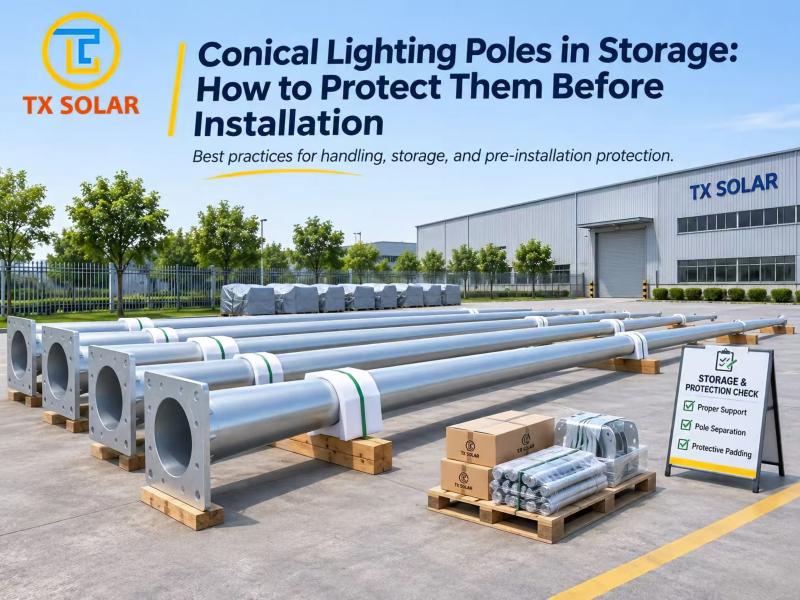
1. Choose a Suitable Storage Location
The first consideration is the condition of the storage area.
Conical lighting poles should be placed on firm, reasonably level ground with adequate drainage. Areas where rainwater regularly accumulates should be avoided, especially when poles will remain outdoors for an extended period.
Direct contact with soil, mud, or standing water can expose the pole surface to unnecessary contamination and prolonged moisture.
If outdoor storage is unavoidable, the poles should be raised above the ground using suitable supporting materials.
The storage location should also provide enough space for lifting equipment and inspection activities without requiring frequent movement of the poles.
2. Use Proper Supports to Prevent Deformation
Unlike uniform-diameter steel tubes, conical lighting poles gradually decrease in diameter from bottom to top.
This tapered structure requires particular attention when arranging horizontal storage.
Poles should be supported at suitable positions using stable timber blocks, padded cradles, or other supports designed for the load. The support arrangement should prevent rolling and avoid excessive pressure at individual contact points.
When multiple poles are stored together, direct metal-to-metal contact should be avoided. Suitable separators can reduce scratches and prevent the galvanized or painted surfaces from rubbing against each other.
Stacking height and arrangement should be determined according to pole dimensions, weight, and the stability of the supporting system.
Poorly arranged stacks may damage the surface finish or create safety risks during subsequent handling.
3. Protect Galvanized Surfaces From Trapped Moisture
Hot-dip galvanizing is widely used to protect steel lighting poles against corrosion. However, newly galvanized surfaces may develop white corrosion products when moisture becomes trapped between closely contacting surfaces without adequate ventilation.
This condition, often called wet storage stain, can occur when galvanized components remain wet for extended periods.
For this reason, conical lighting poles should not be tightly wrapped in non-breathable materials during long-term outdoor storage unless the packaging system is specifically designed to manage condensation.
Adequate air circulation and drainage should be maintained around the stored poles.
If surface staining appears, its severity should be assessed before cleaning or repair. Minor superficial staining and significant zinc coating deterioration require different treatment.
4. Keep Flanges, Access Doors, and Accessories Protected
The pole shaft is not the only component requiring attention.
Base flanges, access doors, mounting brackets, and supplied fasteners should also be protected during storage.
Flange surfaces and anchor bolt holes should be kept free from excessive dirt, hardened concrete residue, and mechanical damage that could interfere with installation.
Access doors should remain secured or be stored in clearly identified packaging to prevent loss and mismatching.
Bolts, nuts, washers, and other small accessories should be packed separately in labeled, moisture-resistant containers where appropriate.
For projects involving different pole heights or configurations, clear identification can prevent installation teams from selecting incorrect components.
5. Avoid Unnecessary Movement During Storage
Repeated handling increases the possibility of accidental damage.
Moving long conical lighting poles across a crowded construction site may result in collisions with other materials, scratches from lifting equipment, or impacts at the narrow upper end.
Contractors should establish a designated storage area where the poles can remain until installation is scheduled.
When lifting is necessary, suitable lifting equipment and approved lifting methods should be used. Protective slings or padding can help reduce contact damage.
Poles should never be dragged directly across concrete or rough ground.
A planned handling route also helps reduce unnecessary movement and improves site safety.
6. Inspect the Poles Before Installation
Even when proper storage procedures have been followed, a final inspection is recommended before installation.
The inspection should confirm that the pole remains consistent with the approved project requirements.
Particular attention should be given to visible straightness, surface condition, flange integrity, access-door fit, and mounting interfaces.
Any scratches, coating damage, or signs of deformation should be evaluated before the pole is erected.
Where repairs are required, the repair procedure should follow the applicable coating specification and manufacturer recommendations.
Keeping a simple storage and inspection record can also help contractors identify when damage occurred and coordinate corrective action before installation work begins.
Conclusion
Proper storage is an often-overlooked part of conical lighting pole project management. Even well-manufactured poles can experience avoidable damage when placed on unsuitable ground, stacked incorrectly, exposed to trapped moisture, or handled repeatedly.
By choosing appropriate storage locations, using stable supports, protecting individual components, and conducting inspections before installation, contractors can reduce unnecessary repair costs and help maintain project schedules.
As a professional lighting pole manufacturer, TIANXIANG supplies conical lighting poles for various outdoor lighting applications. We recommend that customers establish suitable storage and handling procedures based on the pole dimensions, surface treatment, and actual construction-site conditions to help ensure that every pole reaches the installation stage in good condition.
Post time: Nov-06-2026


